

Printed Beach Towels
- Price, low to high
- Price, high to low


 Made in Portugal
- Eco-friendly















- Made in Portugal
- Eco-friendly


- Made in Portugal
- Eco-friendly


- Made in Portugal
- Eco-friendly



- Made in Portugal
- Eco-friendly


- Made in Portugal
- Eco-friendly


- Made in Portugal
- Eco-friendly


- Made in Portugal
- Eco-friendly


- Made in Portugal
- Eco-friendly


- Made in Portugal
- Eco-friendly


Treat your clients and employees!

FAQ - Branded Beach Towels
Trusted by 1,000+ companies
How fibre decides everything else about branded bath towels
Picture a spa guest reaching for the welcome towel folded on the bed. Whether it reads as a generous gift or a thin afterthought is settled by fibre before colour, size or logo enters the conversation. Fibre is the first decision and it constrains all the others.
Cotton terry dominates branded towels because the looped pile drinks water, stays soft and gives thread a firm bed to sit in. Within cotton you can choose combed cotton, ringspun and, where confirmed for your chosen base, longer-staple Egyptian or Turkish cotton, each with its own handle against the skin.
Step outside pure cotton and the brief changes. Cotton-polyester blends, microfibre and flat woven styles each answer a narrower need: a hard-wearing gym towel, a quick-dry travel format, or a smooth velour face built to carry print. Blends trade a little absorbency for faster drying and a lower price per piece.
Loop length is the signal most buyers miss. A long, dense pile feels luxurious in the hand, while a shorter loop dries faster and packs flatter for posting. Colour behaves with fibre too, so cotton holds deep dyed shades, microfibre takes sharp photographic print, and your palette can quietly narrow the fibre list before any decoration is fixed.
Settle the fibre against how the embroidered bath towel will actually be used, not against a catalogue photo. A poolside towel that meets wet skin and grit asks for different cloth than a boardroom gift handled once and admired. Tell us the room, the wash regime and the moment of contact, and the right fibre usually picks itself from a short list.
GSM, cotton grade and weight: reading branded bath towels by the gram
A 320 GSM gym towel and a 600 GSM bath sheet can share a cupboard yet feel like different products entirely. GSM, grams per square metre, measures pile density, which is exactly what your hand reads as softness and your budget reads as cost. It is the single most useful number on any embroidered bath towel quote.
Lighter towels around 300 to 400 GSM dry fast, pack flat and hold the unit price down, which suits gym, travel and high-volume event giveaways. Heavier towels from 500 to 700 GSM feel plush and considered, the right note for spa retail and hotel rooms where the handle is the message.
Cotton grade then layers on top of weight. Combed cotton, where short fibres are removed before spinning, gives a smoother, stronger yarn that resists pilling through industrial washing. Longer-staple cottons spin a plusher, more absorbent pile, while ringspun sits in the practical middle for high-volume promotional runs that still need to take embroidery cleanly.
There is a ceiling worth respecting. Very heavy towels take longer to dry and cost more to launder. A 550 GSM bath towel is often the sweet spot between a premium handle and everyday usability for a busy club. Note too that absorbency comes from the loop, not the fibre alone, so two towels at one GSM can dry differently by construction.
The table below sets weight and grade against use, so you can pick a base before fixing colour or logo. For sampling, a single towel at your target GSM lets you feel the weight and check a stitch before scaling, which removes the guesswork from a larger commitment.
- 300-400 gsm for gym, sports and quick-dry giveaways
- 450-550 gsm for everyday hotel, spa and retail towels
- 600 gsm plus for luxury bath and executive gifts
- Beach formats from 75x150cm for full-length lounging
- Velour or microfibre faces for sharp sublimation print
- Combed cotton for a softer, longer-lasting handle
- Lighter weights pack flatter and lower your unit price
| Fabric / weight | Feel | Best use |
|---|---|---|
| Cotton 300-400 gsm | light, fast-drying | gym, sports, giveaways |
| Cotton 450-550 gsm | soft, everyday | hotel, spa, retail |
| Cotton 600-700 gsm | plush, heavy | premium gifts, luxury bath |
| Egyptian or Turkish cotton | long-staple, very absorbent | high-end branded sets |
| Microfibre | ultra quick-dry, compact | travel, beach, fitness |
| Organic cotton (on request) | soft, certified on request | eco-led brands |
Promotional bath towels and the velour-front rationale
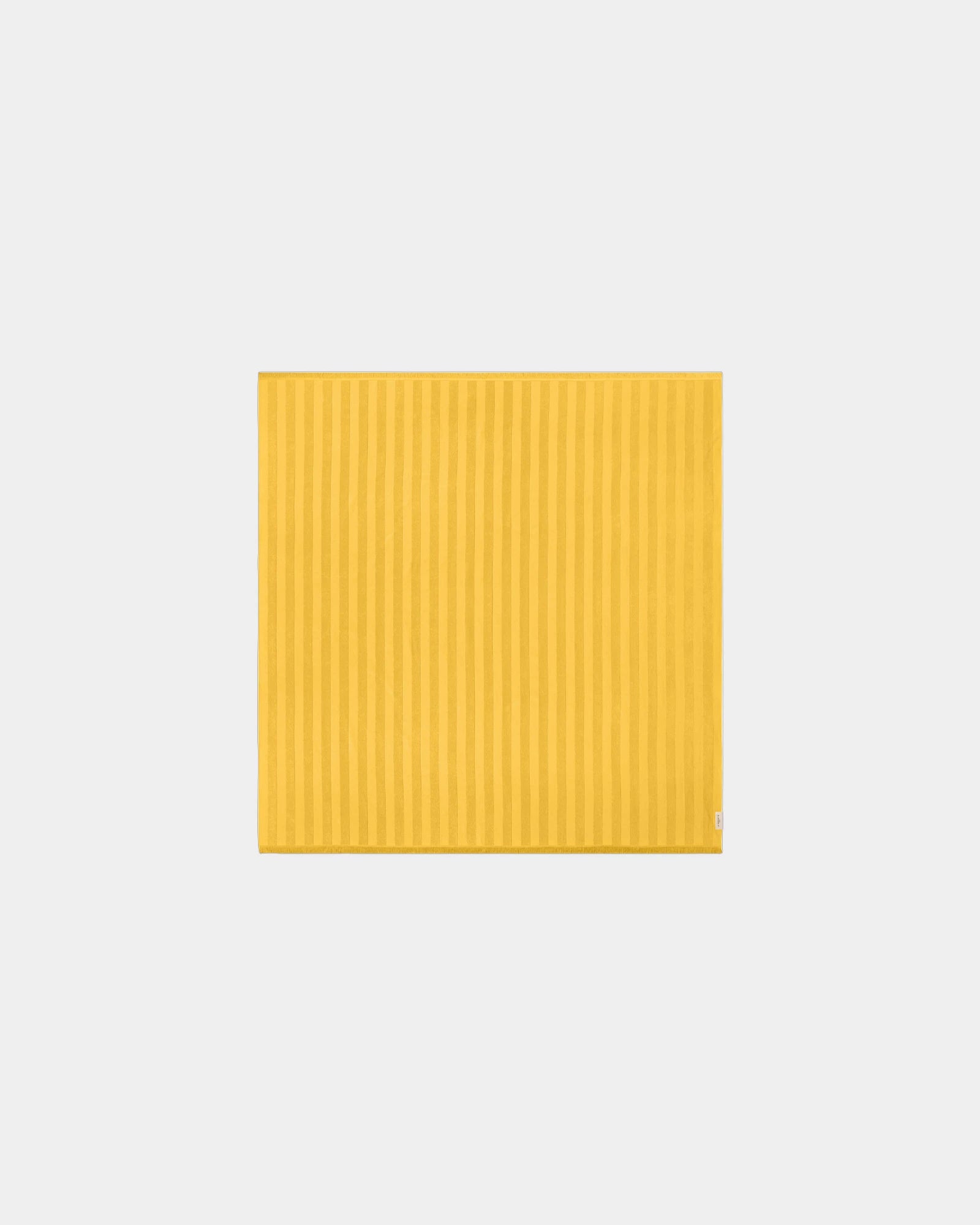
A festival stall hands out 800 towels in a weekend, and every one is unfolded against a crowded field, not a quiet spa shelf. That setting is why beach towels are built differently. Full-colour print, not stitching, suits imagery, and dye sublimation drives ink into a polyester or microfibre velour face so the artwork becomes part of the cloth.
Beach towels run longer and slimmer than bath towels, typically 75 x 150 up to 90 x 180cm, so a sunbather lies full length on the cloth. That extra length is the format's whole point and the first thing to fix when you brief a resort or summer run.
The smooth velour front over a looped back is the engineering that earns its keep. The front takes an edge-to-edge image and sheds sand with a shake, while the looped back stays absorbent. A deep terry pile, by contrast, traps grit and stays damp on a lounger, so we steer poolside and beach briefs to a flat-faced base every time.
For resorts, swim clubs and festival merchandise, a bold all-over print reads across a busy beach where a small stitched logo vanishes. These embroidered bath towels suit lounger sets, resort retail, festival stalls and seasonal giveaways. To round out a summer kit, add Branded lip balms so recipients carry sun-care in a pocket beside the towel you have printed.
Embroidered Bath Towels and where stitching beats print
How embroidered bath towels are stitched
Embroidery is the natural finish for embroidered bath towels of real quality. Thread sits raised against the pile, catches the light and survives years of hot commercial washing. That durability is exactly why hotels, spas and clubs lean on stitched logos rather than a surface print that can wear thin.
We digitise your artwork into a stitch file, then run it on multi-head machines so every embroidered bath towel in the batch matches. Stitch count rises with detail, so a busy crest costs more to run than a simple wordmark, and we cost that into the quote before anything goes to the floor.
Thread choice matters more than buyers expect. Polyester thread holds colour through bleach and high temperatures better than rayon, the safer pick for towels facing commercial laundering. Placement is part of the brief too, with a corner logo reading neatly on an embroidered bath towel and a centred crest suiting a folded spa-shelf display.
Stitch behaviour also shifts with the cloth beneath it. A dense, high-GSM pile gives thread a firm bed and a crisp raised finish, while thin embroidered bath towels may need a stabilising backing to stop the design puckering. We match the digitising to the weight you have chosen so the logo sits flat and clean on the pile.
Monogramming on embroidered bath towels
Monogramming is the gifting variant of the same craft. Single initials or short names personalise wedding, anniversary and welcome-pack towels, and we vary the name per piece without restarting the run. We can stitch most towels from approximately 25 units, so a small first order is workable, and you approve a stitched proof before any production starts.
Branded Bath Towels by size, from face cloth to bath sheet
A hotel furnishing 60 rooms needs a bath sheet, an embroidered bath towel and a hand towel per bathroom, all carrying one embroidery position. Size shapes how a towel is used, priced and decorated, so the format decision comes before the artwork rather than after it.
A standard bath towel covers most adult drying, a bath sheet wraps fully and reads as the more generous gift, and a hand towel anchors washroom sets below them. Branded Bath Towels usually sit at the centre of a range, with face cloths and bath sheets added around them for rooms and gift sets.
Gym and leisure clubs often want a mid-size sports towel that fits a kit bag, whereas resorts pair a hand towel with a bath sheet per room. Print and stitch area scales with the towel. A bath sheet gives a generous border for a large crest, while a face cloth limits you to a compact corner mark and rules out an oversized design.
The table below maps common sizes to use, so you can match format to audience before briefing artwork. Pick the size first, because the print or stitch area you can offer follows directly from the towel you choose.
| Type | Size approx. (cm) | Feature | Typical use |
|---|---|---|---|
| Face cloth | 30 x 30 | Small, square, low unit cost | Spa sets, hotel rooms, samplers |
| Guest / hand towel | 40 x 60 to 50 x 90 | Compact, broad embroidery corner | Washrooms, events, gifting |
| Sports / gym towel | 40 x 90 to 50 x 100 | Slim, kit-bag friendly | Gyms, clubs, resale |
| Bath towel | 70 x 130 to 70 x 140 | Standard adult drying size | Staff kits, leisure resale |
| Bath sheet | 90 x 150 to 100 x 180 | Large, wraps fully, premium feel | Hotels, executive gifts |
| Beach towel | 75 x 150 to 90 x 180 | Long, printable velour face | Resorts, festivals, summer promos |
Choosing a decoration method for embroidered bath towels
Every decoration route on a towel is a trade between photo reach, wash durability and the quantity at which it makes sense. Embroidery gives a raised, hard-wearing logo in solid colours. Sublimation carries full-colour imagery on a synthetic face. Woven branding builds the design into the cloth, and printed borders sit between them.
Run size steers the route as much as the artwork does. Short runs suit embroidery and sublimation for their low setup, while larger hospitality orders open woven jacquard and dye-to-match economies that bring the unit cost down. Pairing the right base to the right quantity is where we save you money on a quote.
The grid below sets the methods against each other on photo reach, durability and rough starting quantities. Read the minimums loosely, since fibre and design move them, and treat the table as a shortlist rather than a fixed menu.
| Method | Principle | Colour / photo | Durability | Min qty approx. |
|---|---|---|---|---|
| Embroidery | Thread stitched into the pile | Solid spot colours, no photo | Very high, survives hot washing | Approx. 25 to 50 |
| Dye sublimation | Ink fused into a synthetic face | Full colour and photo capable | High, will not crack or peel | Approx. 25 to 50 |
| Woven jacquard / dobby | Design woven into the cloth | Tone-on-tone, limited colours | Permanent, part of the weave | Approx. 100 plus |
| Printed border / pad | Ink applied to a flat band | Limited spot colours | Good on the printed area | Approx. 50 to 100 |
| Woven name tab | Stitched-in branded label | Logo in label form | Permanent, discreet | Approx. 100 plus |
Matching the method to the run size on promotional bath towels
A trial of 30 staff towels and a 1,500-piece hotel rollout point to different routes for the same logo. Method follows quantity because setup cost behaves differently across the techniques. Embroidery and sublimation digitise once and run cheaply at low volume, so they carry a short trial without a heavy setup penalty.
Woven jacquard and dye-to-match flip that maths. Their loom or dyeing setup is a fixed cost that only spreads thin across a large run. That rewards hotels, large campaigns and recurring lines, rather than a one-off batch where the setup dominates the bill. A digitised embroidery file or a loom setup is then held and reused, so a later season matches without paying setup twice.
Fibre and GSM layer on top of volume. A high count of mid-weight ringspun cotton reads very differently on a quote than a small batch of heavy long-staple bath sheets. The grid below pairs quantity bands to method, read loosely since fibre and decoration nudge the thresholds either way.
| Quantity | Recommended method | Unit-price tendency | Suitability |
|---|---|---|---|
| Approx. 25-50 | Embroidery or sublimation | Higher per unit, low setup | Samples, small teams, trials |
| Approx. 50-150 | Embroidery, printed border | Moderate, balanced setup | SMEs, single events, gifting |
| Approx. 150-500 | Embroidery or full print | Lower per unit at volume | Clubs, staff rollouts, resale |
| Approx. 500-2000 | Woven jacquard, dye-to-match | Low per unit | Hotels, large campaigns |
| 2000 plus | Woven, optimised tooling | Best volume pricing | National promotions and stock |
Jacquard, dobby borders and woven branding on branded bath towels
A boutique hotel that wants its name read as texture, not ink, is the natural home for woven branding. The design is built into the cloth itself. A jacquard towel carries your pattern or logo as part of the weave and never wears off, because no ink or thread sits on the surface to abrade.
Dobby borders are the lighter-touch version, giving a textured band near the hem that lifts a plain towel into something considered. They suit hotels and spas that want an own-label feel without committing to a full custom weave across the whole cloth.
Tone-on-tone is the usual look, where the pattern shows through texture rather than colour contrast. It reads as quiet and premium, which is why it works for restrained brands wanting recognition without a loud printed logo. The minimum runs higher than embroidery because the loom is set up for your design alone.
Where a stitched logo on a flatter, lighter cloth is closer to your brief, Embroidered Towels cover that ground with a broad colour list. We will help you weigh woven against stitched against printed for your exact use rather than steering you to one habit.
Microfibre and quick-dry promotional bath towels for gym and travel
A swim squad packing for an away gala wants a towel that dries the body, wrings out and air-dries before the coach pulls in. Microfibre answers that brief where plush cotton cannot. The fine synthetic fibres dry fast, then pack small and stay light in a kit bag without terry bulk.
That portability makes microfibre a favourite for festival merchandise and outdoor brand giveaways. It is also the natural canvas for full-colour print, since the smooth synthetic face takes dye sublimation sharply. You get a hard-wearing, fast-drying towel that carries photographic artwork cotton terry cannot match for image clarity. For a flat cotton weave that takes the same logo into the kitchen, Personalised tea towels extend a hospitality range beyond the bathroom.
Care differs and is worth passing on. Microfibre prefers a cooler wash and tumble-dries on low or air-dries within an hour. A short care line on the pack keeps it performing through repeated gym and travel use, well beyond the first month. Gyms briefing microfibre often build a wider wash kit for the same members.
Pair the quick-dry towel with Custom soaps in the changing room, both branded from one artwork for a consistent club identity.
Colour, borders and matching promotional bath towels to your brand
A crisp white spa towel and a charcoal gym towel send opposite signals before a logo is even added. Colour is where a range starts to look like your brand rather than a generic blank. Cotton terry holds deep, saturated dyed shades well, so a body colour near your palette anchors the whole set before a logo lands.
Contrast borders sharpen the effect. A woven or printed band in a second brand colour frames a plain towel and gives an embroidered corner logo something to sit against. That lifts a simple piece into a coordinated product that reads as deliberate rather than off-the-shelf.
Stock colour ranges are broad on most cotton bases, while bespoke dye-to-match becomes possible at higher volumes for an exact brand shade. We will tell you when a stock colour gets close enough to avoid a custom dyeing minimum rather than push you toward one.
Think about the room the towel lives in. A dark towel hides poolside and gym marks, while a white spa towel signals freshness and shows off a tonal woven border. For a wider kit that travels with it, pack a bath sheet into Personalised weekend bags to build a gift set around one carrier.
Sectors and named use cases for branded bath towels
A 200-member leisure club ordering for the new-year intake shows how sectors split. Spas and hotels favour heavy combed-cotton bath towels with discreet embroidery or a woven border, gyms reach for lighter microfibre, and resorts choose printable beach towels for the lounger.
Leisure clubs frequently order across the range at once, mixing resale bath sheets with branded gym towels for members and staff. Matching the logo treatment across formats keeps the brand consistent from the changing room to the retail shelf and back to the lanyard.
Corporate gifting leans the other way, toward fewer pieces at a higher feel. A heavy long-staple bath sheet with a discreet stitched monogram reads as a considered present, where a thin printed throwaway would undercut the gesture. Match the weight to the recipient, because the contact point is the whole message in a one-to-one gift.
Festivals, summer campaigns and outdoor brands gravitate to full-colour beach towels. A bold all-over print works harder there than a small stitched logo on a crowded beach or in a social photo. Schools, swim squads and clubs instead want a durable mid-weight cotton towel that survives constant washing, often with a stitched crest or monogram.
Outdoor teams often want a wearable beside the towel, so Custom caps carry the same embroidered logo onto headwear and keep a summer staff kit consistent from lanyard to lounger. The pattern is simple: heavier cotton and stitching where the room is calm, lighter synthetics and bold print where it is busy or wet.
Care, washing and getting embroidered bath towels to last
Care decides how long your branding survives, so it is worth setting expectations with recipients. Embroidered bath towels and woven towels handle hot domestic and commercial washing well, which is why they suit anything kept in regular service across a club or hotel.
Printed beach and microfibre towels prefer a gentler routine. A cooler wash on a low spin protects both the quick-dry function and the sharpness of a sublimation print, so a short care label earns its place in the pack. First-wash shrinkage is normal on cotton terry, which is why every size we quote is approximate.
Fabric softener is the quiet enemy of absorbency, coating the loops and reducing how much water a towel takes up. We advise leisure and hospitality clients to skip it in commercial laundering to keep towels working at their best for the length of their service life.
An embroidered bath towel may lose a centimetre or two on its first hot wash, then settle and hold that size for the rest of its life. This is normal cotton behaviour and does not affect everyday use, so plan the order around the post-wash size rather than the pristine label dimensions.
We test wash behaviour against your exact build, not a generic rule, because fibre, GSM and decoration together decide longevity. To carry that thinking into a poolside set, slip a printed beach towel into Personalised beach bags so the carrier shares the same branding.
Sustainability and the longer life of embroidered bath towels
The honest answer on sustainability is that it depends on the base you choose. Organic cotton and recycled-blend towels are available on request, stated in the product spec rather than promised across the whole range. We shortlist them clearly against a standard cotton equivalent so you can compare feel and price side by side.
A certification such as OEKO-TEX applies only where the specific towel you order carries it, never as a blanket claim. Where a base does hold it, the cloth has been tested for harmful substances, and we state it solely against that exact towel rather than the catalogue.
Longevity is itself the strongest sustainability argument here. Well-made embroidered bath towels that stay in daily use for years quietly displace several thinner giveaways, so durability and a lower footprint pull in the same direction. That is also why a towel beats a leaflet: the contact point keeps your logo in service long after a flyer is binned.
Recycled-content microfibre and blended cotton are worth raising if a low-impact story matters to your audience. Personalised Hammam Towels add a lighter, flatter weave to a mixed eco-led gift set, sitting alongside terry towels where a single fibre would not cover every use.

