

Branded Business Shirts




Treat your clients and employees!

FAQ - Printed Short Sleeve Shirts
Trusted by 1,000+ companies
Open Collar, No Tie: Why Branded Short Sleeve Shirts Read Differently
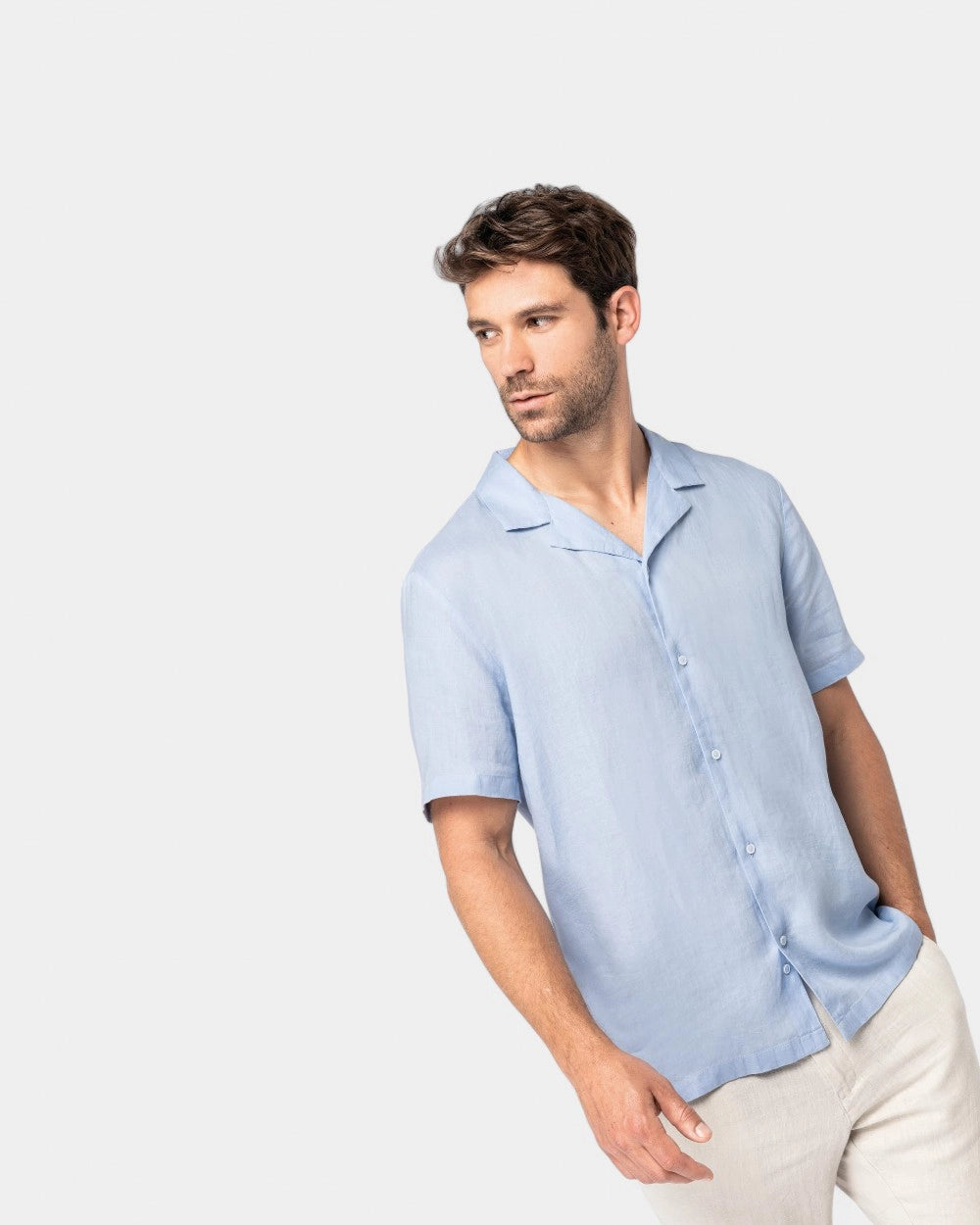
The defining feature of a branded short sleeve shirt is the open neck. It is almost always worn without a tie, so the collar carries the whole look on its own. A collar that gapes, curls or flops at the points turns a smart shirt scruffy by mid-afternoon. That is why we treat collar structure as the first decision on any warm-weather order.
A lightly fused or wired collar holds its shape on an open neck through a long shift, where a fully soft collar can wilt once it warms up. The points need enough interlining to stand without a tie pulling them down. We match collar stiffness to the role, firmer for a hotel desk that has to look pressed at 6pm, softer for a relaxed events team.
Sleeve finish matters as much as the collar. A short sleeve is hemmed rather than cuffed, and a hem with a turned-back facing sits cleaner than a single raw fold. On a fitted cut the sleeve ends just above the elbow and tapers slightly, so it does not balloon. A boxier classic shirt cut keeps a fuller, straighter sleeve for ease of movement. Where a more relaxed open neck suits the role, Promotional Short Sleeve Polo Shirts run a softer collar still and share the same crest.
Poplin And Oxford: The Two Weaves For Personalised Business Shirts
Reading the weave on custom short sleeve shirts
The weave on branded short sleeve shirts is a comfort decision before a style one. A smooth poplin keeps a reception team cool, while a textured oxford trades a little airflow for hard-wearing structure, so the room temperature steers the pick.
Two weaves cover almost every warm-weather order, and the choice changes how the branded short sleeve shirt wears in the heat. Poplin is a tight plain weave, lightweight and smooth, that breathes well and presses to a crisp formal face. It is the default for hospitality and reception teams who need a sharp open collar without weight on the shoulders through summer.
Oxford works on a basketweave, giving a textured, marginally heavier face that takes knocks better than flat poplin. It comes across a shade more relaxed and rugged, fitting a security or front-of-house post in daily contact. Pinpoint oxford bridges the gap, a finer version that holds slight texture yet presses neater for an adviser desk.
Weight is the part buyers underestimate on a summer shirt. A poplin around 110 to 120 g/m² stays cool on a hot reception floor, while an oxford near 130 to 145 g/m² keeps its structure but wears warmer. We check that weight bracket against how warm your interior runs, because a top too heavy in July is the quickest way to lose staff goodwill.
| Weave | Typical weight | Feel in heat | Best for |
|---|---|---|---|
| Poplin | 110-120 g/m² | Light, breathable | Hotel and reception desks |
| Pinpoint oxford | 120-135 g/m² | Smooth, mid-weight | Advisers and offices |
| Classic oxford | 130-145 g/m² | Textured, hard-wearing | Security and front-of-house |
| Easy-care blend | 110-140 g/m² | Cool, fast-dry | High-rotation summer teams |
The Chest Pocket And Left-Chest Embroidery On Custom Short Sleeve Shirts
Why stitch leads on personalised business shirts
Embroidery is the natural chest finish on a personalised business shirt, since the open neck offers no cuff for a second mark. A sewn crest holds its tone through nightly washes where a print can dull, so thread carries the brand across a full summer rota.
Most short sleeve business shirts carry a single patch pocket on the left chest, and it changes where the logo sits. A sewn crest sits above that pocket, roughly 7 to 9 cm across, never on the flap where a biro or pass card would hide it. We keep the badge off the pocket seam so it lies flat instead of catching the stitched edge.
For an open-neck uniform garment, stitch is the natural chest finish, because no cuff exists to carry a second logo. Thread keeps its tone and outline through a season of overnight washes, while heat-applied marks can dull or split sooner. A breast crest tends to use two to four thousand stitches, and a woven backing keeps slim lettering crisp on featherweight poplin. Embroidered Polo Shirts wear that identical sewn crest at a matched height, so a floor mixing both garments still scans as one kit.
Your logo is converted to a stitch file just once, after which we run a proof for you to approve ahead of production. Free artwork approval within 24h puts the actual sewn mark in front of you, not a screen render, before any cloth is cut. Every later reorder pulls that same file, so a branded short sleeve shirt added next summer lines up with this season's batch.
Easy-Care And Wrinkle-Resist: Branded Short Sleeve Shirts That Skip The Iron
No summer crew has time to press a rail of branded short sleeve shirts before clocking on, so wrinkle resistance sits at the centre of the brief. A polyester-rich mix, commonly in the region of two-thirds polyester to one-third cotton, throws off creasing and dries quickly, keeping a neat open neck across a long standing shift. All-cotton wears cooler and breathes better, yet crumples harder and wants the board.
Crease-release and non-iron finishes prove their worth wherever staff drip-dry overnight. As the cloth dries on the hanger, the treatment lets creases drop out, so it looks pressed with no board involved. The cure relaxes gradually across dozens of warm cycles, meaning a shirt two seasons old comes up marginally softer than a fresh one. Holding a modest reserve from day one keeps a long-running rota uniform.
When heat meets movement, a stain-release treatment lets a coffee spill or sauce smear release in an ordinary cycle instead of fixing into the fibres. We spell out the precise mix and any wrinkle treatment garment by garment, so the laundry rule you give staff genuinely holds up. A crew that adds Custom Caps for an outdoor pitch gets the matching low-maintenance logic on the headwear. Where organic cotton is offered, the status sits on that line's own data sheet, not as a sweeping label over the catalogue.
Fitted Versus Classic: Cuts For Personalised Business Shirts
The cut decides how a branded short sleeve shirt photographs and how it moves. A fitted cut tapers through the body and the sleeve, giving a tailored line that suits a younger brand or a client-facing desk. A classic cut runs roomier through the chest and waist with a fuller sleeve, which a warehouse-office or security role needs for reaching and lifting.
A women's shirt or blouse is cut on its own pattern, contoured at chest and midriff by darts that hold a tidy line under an open neck. Its buttons fasten right-over-left, the front placket is slimmer, and the logo sits a fraction higher to flatter the contoured shape. A team spanning both needs each pattern, never a men's body simply graded down. A graded-down men's block pulls across the bust and gapes at the placket, which shows the moment someone faces a guest. Spec the proper women's pattern and the open collar sits true on every member.
Men's collars are bought by neck measurement, generally spanning a 14.5 up to an 18.5, whereas women's blouses run on dress sizing. We hand over the laid-flat figures, across-chest, sleeve drop and back length, so a chart maps onto your real headcount. Trialling two or three sample sizes ahead of the bulk run lets people check the open neck sits true.
| Fit | Cut | Sizing | Note |
|---|---|---|---|
| Men's classic | Roomier, fuller sleeve | 14.5-18.5 collar | Movement-heavy roles |
| Men's fitted | Tapered body and sleeve | 14.5-17.5 collar | Smart client-facing desks |
| Women's fitted | Shaped at bust and waist | Dress size 8-22 | Darted, clean open-collar line |
| Women's blouse | Softer, draped cut | Dress size 8-22 | Relaxed reception look |
Summer Office, Hospitality And Events: Where Custom Short Sleeve Shirts Earn Their Run
A hotel front desk through August is the clearest case for personalised business shirts. Staff carry an open neck across a ten-hour stint with barely any air to spare, so a light poplin in a deeper tone masks marks and dries by morning. The property badge sits discreetly at the left chest, signalling hospitality over high-street retail. With a wash every night, stitch has to outlive the print it stands in for.
A summer events or exhibition team flips the brief toward visibility. A strong company colour helps a stand crew register across a hot, packed hall, with an enlarged left-chest logo and, on occasion, a reverse print. That same vivid top photographs well for the stand portraits posted to social, so the open neck and badge read clearly under marquee lighting.
Front-of-house and security roles want the hard-wearing end of the range. A textured oxford takes daily contact at a door or a reception barrier without showing wear, and a fuller classic cut gives room to move. For a build or logistics crew working the same event, Embroidered workwear carries the matching crest onto a sturdier layer, so the brand stays single across an entire multi-day job.
Print Versus Stitch On Branded Short Sleeve Shirts
Print holds a slim but genuine role on branded short sleeve shirts, even with stitch leading on the chest. A transfer or screen mark copes with a big back design on an events top, or a soft gradient badge that thread cannot render neatly. Over smooth poplin, a delicate print lies flatter than raised stitching, an effect some hospitality brands chase for an almost-hidden tonal mark. That flat finish suits a logo meant to whisper rather than shout. It also lets a complex full-colour crest land cleanly where stitch would crowd the fine detail.
What you trade is staying power across a season of warm cycles. Stitch lasts longer than nearly any print. On a garment laundered daily we push the chest toward thread and keep print for a back graphic or a single festival batch. Plenty of shirts run both, a sewn chest badge alongside a printed back line for a stand crew, and we price the pair as one so the figure is plain.
The volume decides the split. A modest desk order of thirty to fifty pieces is tidiest as straight stitch, since digitising spreads thin and no screen needs setting up. Several hundred event tops carrying a back design swing the sums toward a printed reverse over a sewn front. For dress-down days, Custom T-Shirts carry that very crest, so a team shifts between codes with the brand intact.
| Placement | Best method | Why |
|---|---|---|
| Left-chest crest | Embroidery | Sharp and durable through daily warm washes |
| Back events graphic | Screen or transfer print | Large area and gradients thread cannot render |
| Tonal hospitality badge | Fine print on poplin | Lies flatter than raised stitch for a subtle mark |
| Mixed front and back | Stitch front, print back | Priced as one job for a stand crew |
Sector Briefs Matched To Branded Short Sleeve Shirts
Hospitality, events and front-of-house teams each pull branded short sleeve shirts toward a different weave, shade and finish. The grid below sets a common role against the build that tends to suit it, so a buyer can shortlist a base before reading a single product page.
| Role | Core need | Recommended build |
|---|---|---|
| Hotel reception | Stays pressed all shift | Light poplin, firmer collar, deep tone |
| Events stand crew | Reads across a hall | Bright easy-care, large chest plus back print |
| Adviser desk | Smart but breathable | Pinpoint oxford, fitted cut |
| Door and security | Takes daily contact | Classic oxford, roomier cut |
| Food and bar service | Sheds spills overnight | Poly-cotton, stain-release finish |
Read the grid as a starting point rather than a rule. A venue spanning several roles often runs two bases off one stitch file. A crisp poplin covers the desk, and a rugged oxford takes the door. The whole team still scans as one kit even where the cloth differs, because the chest crest holds steady across both. That single mark is what lets a mixed rota look deliberate rather than pieced together from separate suppliers.
Shade does quiet work here too. A deeper tone hides marks on a long hospitality shift, while a vivid brand colour earns its place on an exhibition floor. We map the weave, the weight and the shade to the role first, then carry your crest across every base so the open-neck look stays consistent from reception to stand. A muted navy reads as discreet hospitality, where a bright tone reads as event energy. The same logo sits on both, so the brand never drifts as the shade changes by role. That is how one supplier kits a whole estate in a single coherent look.
Specifying A Personalised Business Shirts Order Across A Team
Getting an open-neck garment to fit is fussier than fitting a tee, since a gaping collar leaps out on anyone meeting the public. Rather than guessing, we build the curve from a head-by-head count and an actual size from each person, because half an inch of neck shifts how sharp the look reads. Skewing the buy toward the genuine sizes on your rota, with a handful of spares at each end, stops a heap of leftover mediums.
- Take a neck measurement for collar size, not a guess
- Spec a firmer collar so the open neck holds all shift
- Choose poly-cotton for teams who cannot iron in season
- Keep the stitched crest clear of the chest-pocket seam
- Order both men's classic and women's shaped blocks
- Add a stain-release finish for food and hospitality
- Hold a small spare reserve for new summer starters
A tight brief gets a custom short sleeve shirts order onto your desk as a sample quickly. Give us the role, an approximate count, the weave and shade in mind, plus your brand colours, and that becomes a spec without endless back-and-forth. Naming the date you need them lets us hold your chosen weave instead of falling back on whatever stock allows. The run is then quick: a digitised logo, a sewn proof to approve, then making, with delivery in roughly three weeks. Brief a summer launch over spring and there is slack to settle fits before warm weather hits. Where a crew also issues winter knits, one crest can travel across the seasons. Corporate Gift Boxes for a joiner's welcome pack then echo that single mark over everything a recruit is handed on day one.

