

Personalised Le chocolat des français Products






Treat your clients and employees!

FAQ - Personalised Le chocolat des francais products
Trusted by 1,000+ companies
A branded chocolate escapes the fate of most giveaways
Every corporate handout rests on an unspoken bet: that the item will be used. Most promotional objects lose that bet within days of being handed over.
Food reverses the odds. It gets eaten, therefore it gets used, and that consumption is in itself proof the budget was not wasted.
There is also a multiplier effect that comes with sharing. A bar opened during a break travels between several pairs of hands, and the branded wrapper stays visible throughout.
It triggers something no object triggers: a comment. People talk about what they taste, and that conversation regularly outweighs the price on the invoice.
One British point is worth adding. Corporate handouts here increasingly go by post to home addresses rather than landing on desks, which makes the journey longer and the storage conditions less predictable. A flat wrapper that clears a letterbox avoids both a failed delivery and a spell in an unheated depot.
Our printed chocolate with logo set out the formats available for a large handout.
Three Le chocolat des francais items to personalise
The range we carry from this maker comes down to three entries, which shortens the decision and removes the paralysis that a sprawling catalogue creates.
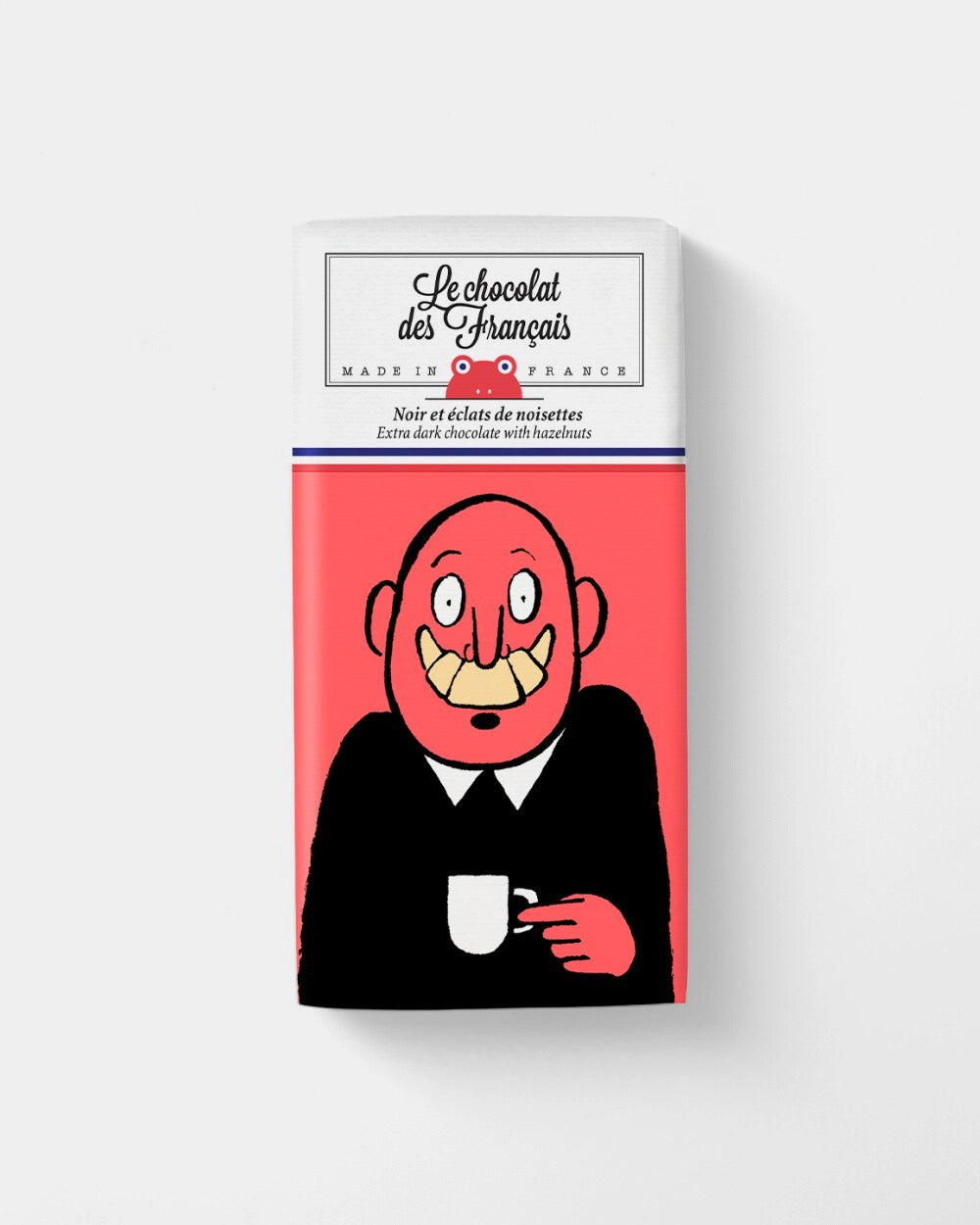
Two bars form the backbone. One is built on an organically farmed milk base, the other on an organic dark chocolate scattered with hazelnut pieces.
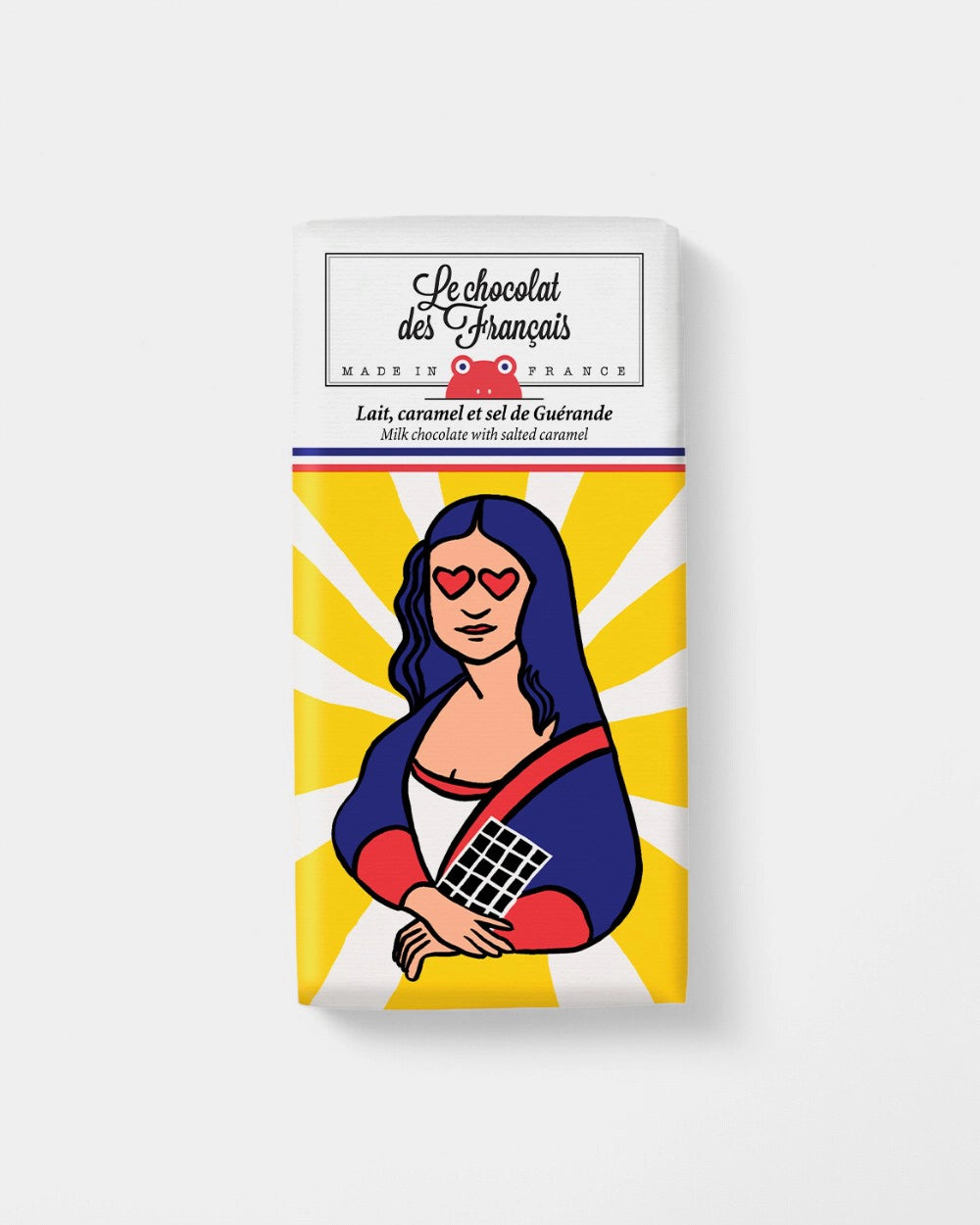
The milk bar comes in two faces, one with almond and one with caramel and Guerande salt. A box of twelve dark chocolate truffles closes the selection.
| Item | Chocolate base | What sets it apart | Format |
|---|---|---|---|
| Organic milk bar | Milk, organic farming | Almond, or caramel with Guerande salt | Single bar |
| Organic dark bar | Dark, organic farming | Hazelnut pieces | Single bar |
| Truffle box | Dark | Presentation box | Twelve truffles |
With so few lines, assembling a coherent set is quick and the tracking of stock and dispatch becomes markedly lighter.
The organic milk bar and its two faces
This first entry pairs an organically certified milk chocolate with a brightly coloured wrapper, the instantly recognisable signature of the house on a shelf.
The almond version plays it restrained. The nut adds a discreet bite and a little length without ever unsettling the softness of the milk.
The salted caramel version creates a far more noticeable tension. The salt reactivates the reading of the sugar and stops boredom setting in after three squares.
For a wide handout, the milk base remains the broadest common denominator. It suits nearly every age and gets eaten at work as readily as at home.
Note in passing that a whole bar looks more generous on opening than an assortment of small pieces of the same weight. Our branded sweets for business widen the sweet selection.
The organic dark bar and its hazelnut pieces
The second item is aimed at a different audience. Built on a powerful organically farmed cocoa, it carries a pronounced bitterness that the hazelnut pieces temper.
Pairing strong cocoa with hazelnut is one of the trade's proven marriages. It works because the natural oil of the nut blunts the dryness without neutralising the character.
This register mainly attracts an adult professional audience, generally more drawn to dark chocolate once tasting becomes deliberate.
The certification here is worth exactly what it is worth on the other bar. It rests on an external, checkable set of rules rather than on a freely chosen adjective.
Note that a higher cocoa content also means a firmer bar, which travels marginally better than a milk chocolate in warm conditions. Our branded biscuits with logo broaden the choice when a single parcel has to satisfy opposing tastes.
The box of twelve dark chocolate truffles
This entry changes register entirely. You are no longer passing a bar around a table but handing over a presentation box, with the weight and formality that implies.
Twelve pieces is the right calibration. Enough to share a few, not enough to turn the gesture into a supply run for the coffee machine.
The box follows the same graphic line as the rest of the catalogue, those assertive colours setting it apart from the standardised gift boxes that come round year after year.
This reference does demand more thermal care than the bars. Its texture shifts quickly, which puts the delivery chain at the front of your concerns.
On a smaller circulation list, the box also carries a value signal the bars cannot match. Handing over a sealed container reads as a considered choice, where a bar reads as a shared snack.
Our corporate food hampers show how a box of this kind fits inside a wider gourmet assembly.
French manufacture as the heart of the proposition
Where the chocolate is made forms the foundation of this house. It is not a line added at the bottom of a spec sheet but the starting point of its positioning.
For a buyer the advantage is immediate. Choosing a product made in a named workshop ties your gesture to a craft you can locate, something an anonymous mass-market bar will never allow.
British buyers tend to read French provenance as a mark of care on food, which is precisely why the argument lands better here than it would on a technical object.
One honest qualification belongs here. Cocoa does not grow in Europe: the French contribution is the work in the workshop, the recipe and the conching, never the farming.
Putting it that way heads off an immediate objection from anyone who knows the supply chain. Our branded French gift boxes gather comparable French-made compositions.
The cardboard wrapper as the only printable area
This is the matter to settle first, well before choosing between the three items on offer.
Nothing can be decorated on the confection itself. It is made to be eaten, and no technique fixes a name onto something that disappears with the first mouthful.
Your mark therefore goes on the card, applied either by digital press or through a screen, depending on the material and the number of units involved.
Oddly, that obstacle works in your favour with this house. Its packaging already counts as design work, which leaves you a wide field and a polished finish.
For each entry in the catalogue we quantify the usable area and the method, then send you a physical proof within two working days.
Digital print or screen print on a food wrapper
A small run or a design rich in gradients settles the question in favour of digital printing. No surcharge appears when the identity multiplies its shades, and photographs come through without difficulty.
Past a certain volume, screen printing becomes the rational choice again, with denser colour, flawless solid areas and adhesion that lasts on card.
The food sector imposes its own rule at this point. Mandatory information physically occupies part of the surface, so the space left for artwork is smaller than expected.
Settle the face to be treated early. On the front, your identity converses with the maker's design; on the back, it slips out of view at exactly the moment the parcel is opened.
Prepare a stripped-back version of your identity as well, since hairlines stop being legible below a millimetre on a wrapper of this size.
What the organic certification actually guarantees
Both bars carry an organic mark. It should not be filed alongside the flattering adjectives a manufacturer prints at will on its own packaging.
Behind the small logo sits a technical standard administered by an outside body. That document exists, can be requested and can be passed on to a procurement team that asks for it.
Any organisation completing sustainability questionnaires grasps the difference at once: you supply a piece of evidence rather than a verbal commitment.
Be careful not to overreach, though. The mark says nothing about how good the chocolate tastes; it concerns how the raw materials were farmed, not the skill of the chocolatier.
One last precaution: date your claims, because standards change and repeating old wording invites an inaccuracy. Our branded eco products gather other items subject to comparable checks.
Choosing when to hand out a branded chocolate
Seasonality governs more here than on any other family, for a purely physical reason: cocoa butter reacts to heat.
The closing weeks of the year open the most favourable window. The habit of giving something sweet is firmly established and low temperatures help the goods survive the journey.
The drawback is familiar. Across those few weeks the sheer number of gestures blurs the memory of each one, which puts the wrapper in a leading role.
Shifting the send-out brings a benefit few managers anticipate. Out of season, branding workshops have more time and carriers more capacity, both to the direct benefit of the product.
Whichever window you pick, work backwards from the delivery date rather than forwards from the order date. Artwork approval, printing and carriage each take time, and the chocolate is the part of the chain with the least tolerance for delay.
Our branded corporate hampers bring together compositions built for the winter period. Avoid high summer, where the risk of a pale bloom becomes real.
Bloom, storage and delivery of branded chocolate
This factor seals whether a campaign works, and it is missing from almost every checklist used before a purchase order is signed.
The pale bloom comes from an abrupt change in temperature: cocoa butter migrates to the surface and forms a dull film, entirely harmless but unappealing to look at.
The taste barely changes; what collapses is the first impression, since people instantly associate that surface with goods left somewhere far too long.
The trouble usually appears after delivery, when the parcel waits beside a radiator or a window. A short storage note included with the shipment noticeably reduces the risk.
Remember too that food carries a best-before date. You buy for a given campaign, never to build a reserve you can draw on across several years.
Building a gourmet hamper around branded chocolate
A single item at the bottom of a padded envelope rarely convinces. Add two matching pieces and the sender's intention reads instantly on opening.
Bringing the two bars together is the simplest assembly to defend: soft on one side, intense on the other, with no need to survey anybody's preferences.
The truffle box provides the structure of the parcel. It supplies the weight and the visual anchor, with the bars arranged around it.
Slipping a non-perishable object into the set extends the life of your name considerably. It survives once everything else has been eaten, which answers the structural weakness of anything edible.
Three chosen items beat six piled in to fill space, and an internal recess cut to size protects the corners in transit.
Keep the parcel tight as well: past three or four items the whole loses legibility and nothing specific stays with the recipient. Our branded gift boxes gather the most requested combinations.
The limits of a branded chocolate, stated plainly
Better to voice the three predictable objections now than to meet them when recipients open their parcels.
The lifespan of the message comes first. The contents are gone in days, the card goes to recycling, and nothing here compares with an object kept on a desk for years.
Dietary questions follow. A nut allergy, a medically prescribed diet or a personal conviction will take the item out of the hands of part of your audience.
Then there is temperature, covered above, which shortens the usable calendar and calls for constant attention to the shipping route.
None of this rules the range out; it sets the right date and the right assembly. Our branded corporate gifts show other options when lasting visibility comes first.
Tax treatment of a chocolate gift in the United Kingdom
Here is the point that matters most on this family, and it is frequently missed. HMRC guidance at BIM45065 sets out when a business gift may be deducted, and food is expressly outside it.
The rule allows a deduction where the gift costs no more than fifty pounds per recipient in a twelve-month period and carries a conspicuous advertisement for the business.
It then excludes gifts of food, drink, tobacco and vouchers exchangeable for goods. Chocolate falls squarely into the food exclusion, so the fifty-pound route is not available for it.
That does not make a chocolate handout a bad idea; it means the cost sits as a non-deductible entertaining expense rather than as a deductible gift, and your budget should be built on that basis.
Where the recipients are employees rather than clients, the trivial benefits rules apply instead, and those carry no food exclusion. Confirm your position with your accountant before a large campaign.

