

Personalised Flotte Products






Treat your clients and employees!

FAQ - Personalised Flotte products
Trusted by 1,000+ companies
A branded waterproof jacket is adopted within days
On clothing budgets, the take-up rate is the figure everyone asks about and almost nobody measures. It nonetheless decides what the spend was actually worth.
Rain settles the question on your behalf. It arrives without a schedule, and whatever is to hand is what gets put on, regardless of whether the garment came from work or from a shop.
The result is a kind of exposure a business rarely buys. Your name travels outdoors, through town, on public transport, well beyond any working perimeter.
The mechanism only works on one condition. The garment has to hold up, otherwise the memory attached to it tips over into disappointment.
There is a British angle worth adding. Rain here is spread across the year rather than concentrated in a season, so a light shell earns its place twelve months out of twelve instead of over a short window. That shifts the question: it is no longer when to hand the garment out, but which model best supports year-round use.
Our branded waterproof jackets set out the models available for kitting out a whole team.
Four Flotte items to personalise, two problems solved
Two weather problems shape this selection, and they are better handled separately than by hoping one garment will answer both.
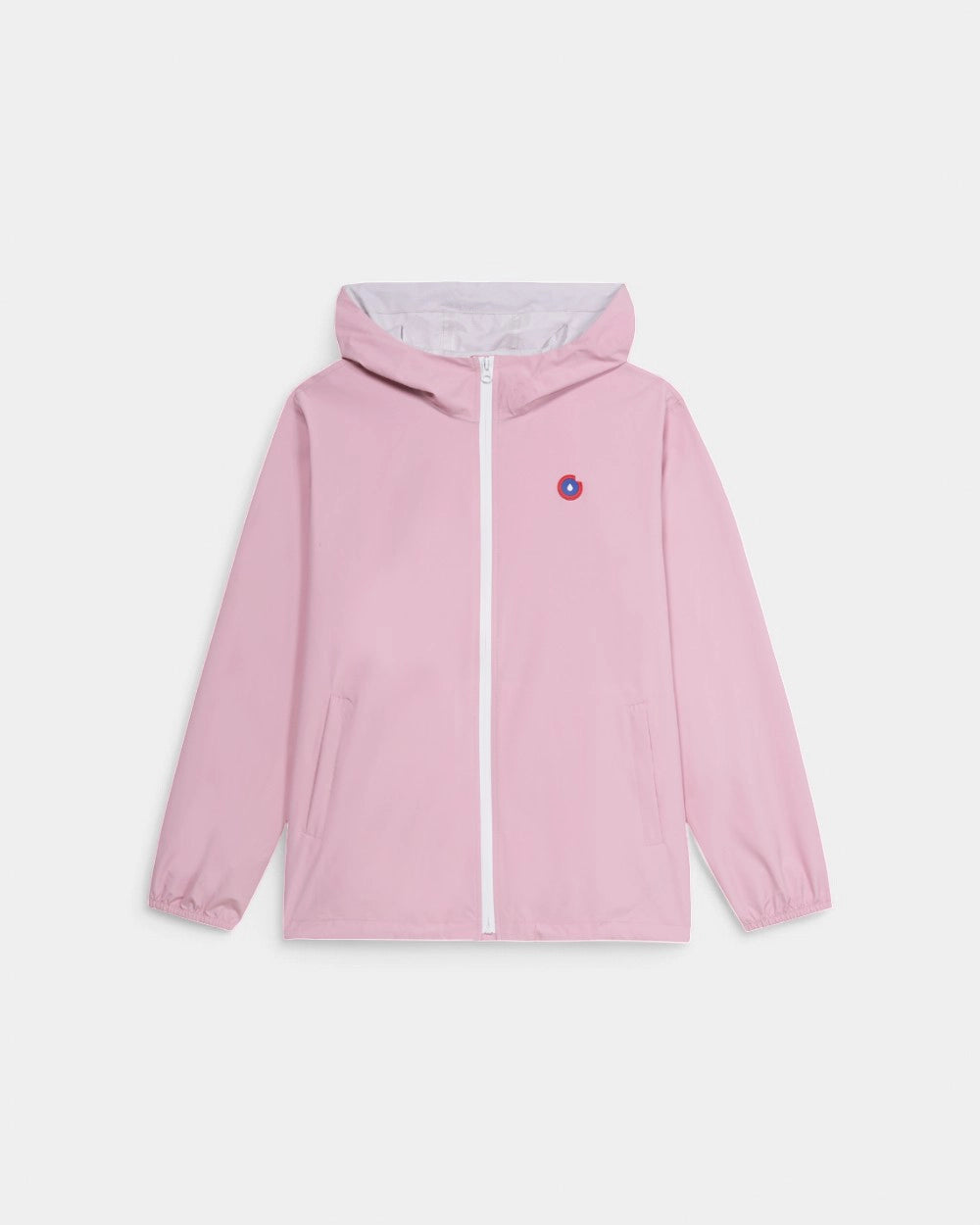
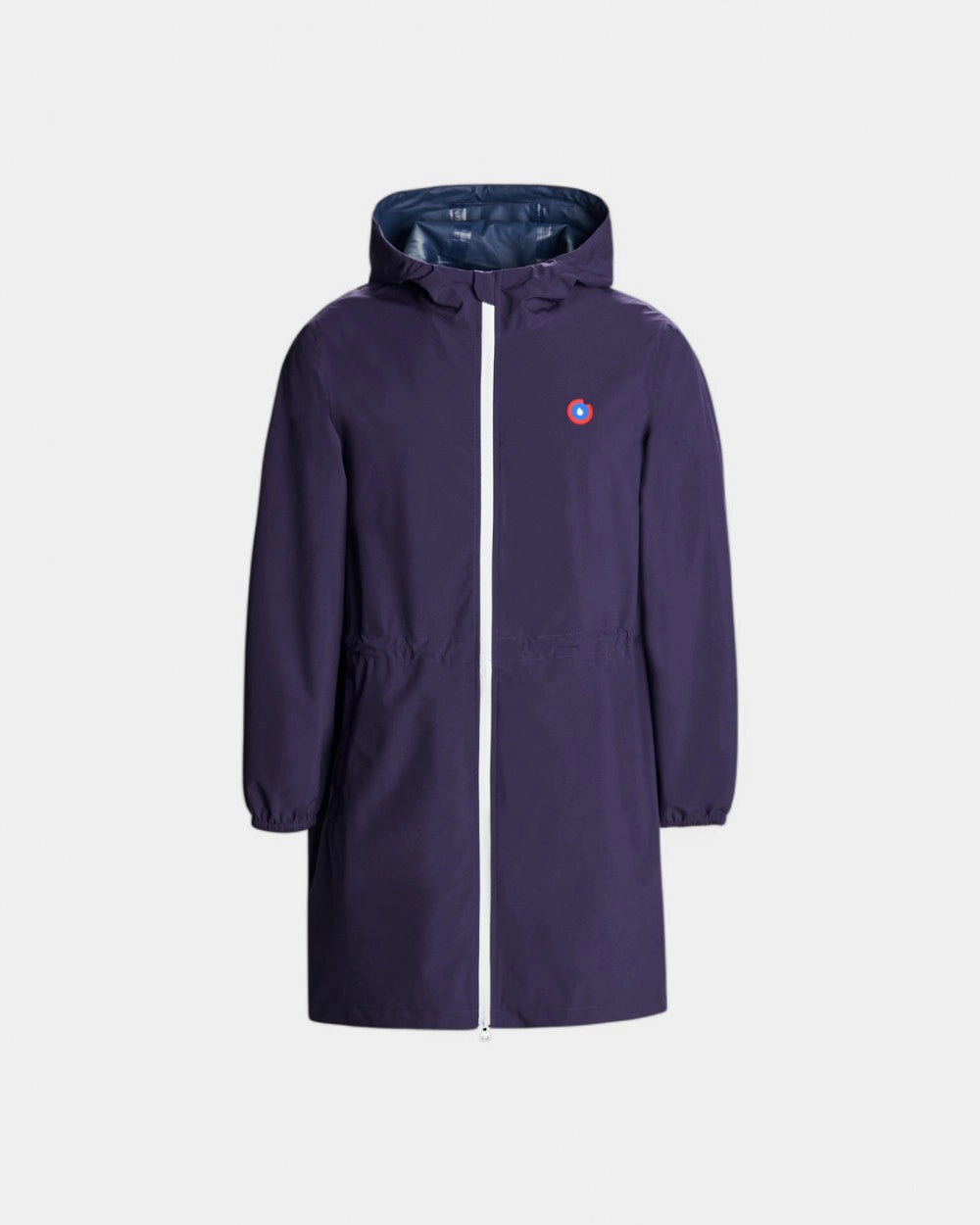
Water calls for a shell. Two references answer it, the Amelot and the Passy, cut unisex and made from recycled polyester.
Dry cold calls for insulation. Two fleeces cover that, one of them sleeveless, and nothing stops you slipping either under a shell when both problems arrive together.
| Item | Fibre | What to note | When it earns its place |
|---|---|---|---|
| Amelot | Recycled polyester | Packs into its own back pocket, two-way zip, taped seams | Daily commuting |
| Passy | Recycled polyester | 10,000 mm and 10,000 g/m²/24h, OEKO-TEX, GRS, PFC-free | Showers and gusts |
| Recycled fleece | 100% recycled polyester | Dense knit, adjustable fit | Autumn and spring |
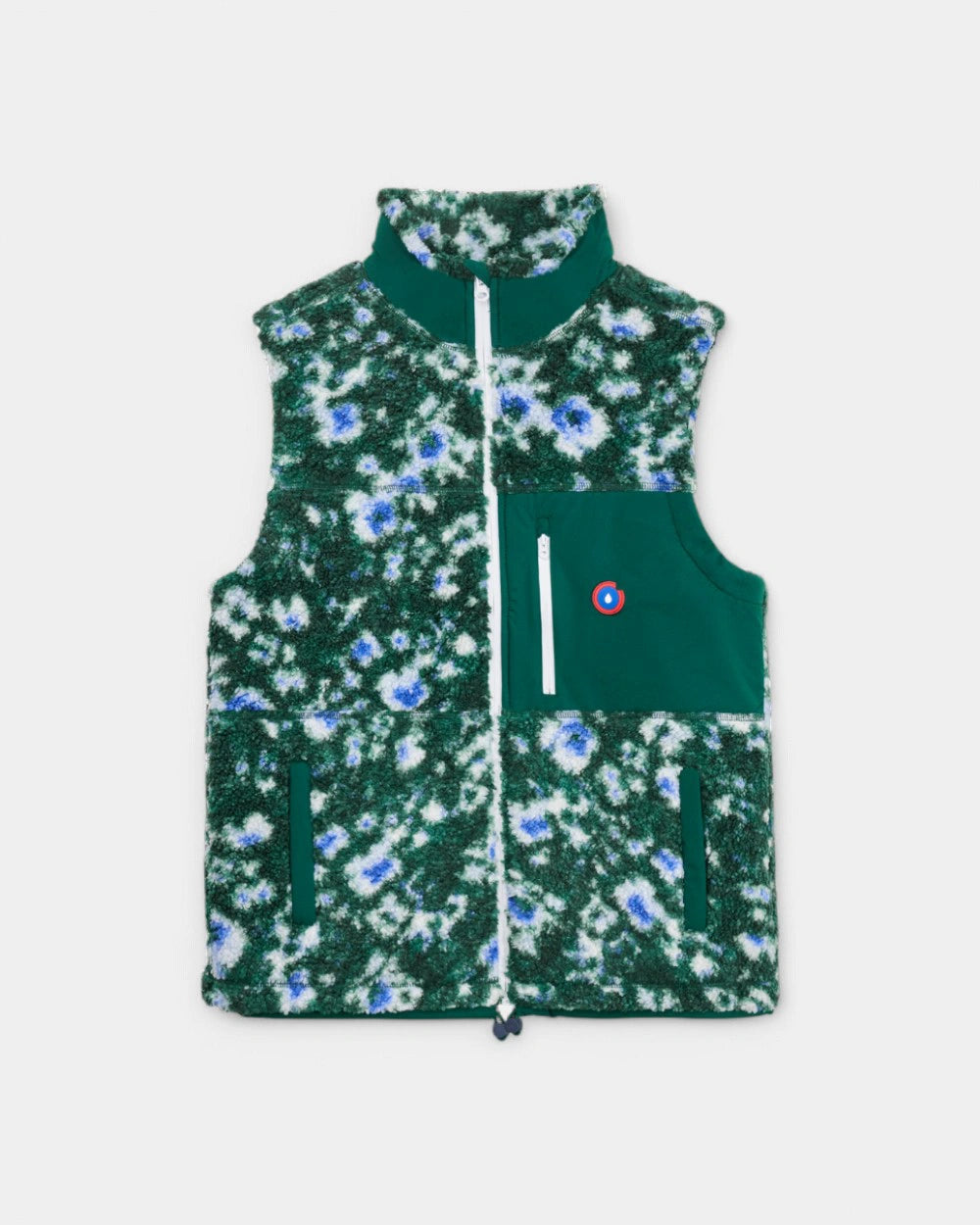
| Sleeveless fleece | Sherpa | High collar, zipped pockets, drawcord hem | Mid-layer |
Reading the range by problem avoids the familiar illusion that a more expensive item removes the need for everything else.
The Amelot jacket and its packable back pocket
This unisex urban shell pairs a waterproof barrier with a stated breathability, and is built from recycled polyester.
Its signature detail sits at the back: a pocket takes the folded jacket and turns it into a small bag, which settles the question of where to put it the moment the shower stops.
The rest of the construction follows the same intent. Taped seams, waterproof zips and zipped pockets to keep whatever you are carrying secure.
The two-way zip deserves its own mention. Opening from the bottom frees the legs, which changes things entirely on a bike.
A waist drawcord finally pulls in the line, which matters on a unisex cut meant to fit very different frames.
One practical note on the packable design: a jacket that lives in a bag gets carried far more often than one that has to be worn or held, which is exactly why this format survives a commute mixing train, walking and an office. Our branded jackets with logo round out this family.
Reading the technical figures on the Passy jacket
This short, light shell targets everyday weather rather than altitude. It too is built from recycled polyester.
Its specification carries two numbers that happen to match but describe opposite things. Ten thousand millimetres on one side, ten thousand grams per square metre per twenty-four hours on the other.
The first concerns water arriving from outside. It expresses the column of water the fabric holds before damp gets through, and therefore how it copes with prolonged rain.
The second concerns moisture produced inside. It expresses the vapour the membrane lets out, meaning the perspiration that does not sit against the skin during exertion.
The rest completes the picture: a bag stowed in the back, drawcords at the hem, an adjustable hood and two zipped pockets. Our branded softshell jackets offer a different approach to the same wardrobe.
Three labels on a technical shell and what each covers
Three marks accompany this model, and treating them as interchangeable would lead you to describe the garment inaccurately to recipients.
OEKO-TEX concerns skin safety. The mark indicates that a search for problematic substances was carried out under a framework held by a third party.
The Global Recycled Standard concerns the material. It puts the claimed recycled percentage through an audit run outside the producing company, where an unverified mention simply prints a figure.
The PFC-free and PFAS-free wording refers to the finish applied to the surface so water beads and runs off. Published work documents how slowly these fluorinated compounds break down.
Bear in mind that all three can be checked with a body outside the supply chain, which separates them from freely used marketing language. They apply to the Passy alone. Our branded eco products gather comparable references.
The recycled fleece as a personalised mid-layer
This piece occupies a different place in the wardrobe. It does not stop rain, it holds body heat, which puts it in the middle position beneath a shell.
Its knit is spun entirely from regenerated polyester, in the same vein as the two rain jackets in the selection.
The adjustable fit lets it cover almost every case: worn on its own while the temperature stays reasonable, slipped underneath once the cold sets in, it never goes into storage for the season.
It is also the easiest reference to brand, since no membrane and no taped seam has to be spared during the process.
Care is undemanding too: a gentle wash and quick drying, with no special handling. Our corporate clothing with logo place this piece back inside a complete wardrobe.
The sleeveless fleece and the sizing question
This gilet is made from sherpa fleece, a looped knit whose fibres trap air and spread warmth across the torso without restricting the arms.
The guiding idea is to insulate the trunk while leaving the upper limbs entirely free. Heat concentrates where it counts and the shoulder keeps its full range, welcome on the road and on site alike.
Nothing superfluous in its build: a collar that rises to shelter the throat, a pair of closed pockets and a drawcord at the hem.
Once quantities grow, this is the piece that goes down best across a whole group. Removing the sleeves takes most of the fit differences out of the equation.
A gilet also layers over a shirt as readily as over a jumper, making it the easiest item to add to an existing outfit. Our branded gilets with logo show neighbouring models when more insulation is needed.
Branding a shell without creating a way in for water
This technical constraint governs the whole family and settles the process long before the budget joins the conversation.
A waterproof shell owes its performance to an unbroken barrier and to treated seams. Any needle passing through the fabric opens a possible route for moisture.
Embroidery multiplies those passages across a few square centimetres, weakening the barrier at precisely the point where the logo is meant to appear.
On these two shells, transfer is therefore the sensible answer. It stays on the surface, pierces nothing, and renders a multi-colour identity properly.
If you insist on the texture of thread, it has to move to a sheltered area: an added tab, an existing lining or a piece stitched over the top. That judgement is made model by model.
Embroidery or transfer on a branded fleece
Fleeces present the opposite obstacle, easier to work around but real enough: their napped surface swallows whatever motif you lay on it.
Embroidery suits them remarkably well. The thread sits on the pile and stands up to it, the depth of the finish works in its favour, and the logo stays readable after many washes.
Transfer remains possible, subject to two known effects. The pile lies down under the heat press and the finish comes out flatter than on a smooth textile.
On sherpa, where the loop is more pronounced, the gap turns firmly in favour of embroidery. A fine line on a very thick knit means simplifying the drawing beforehand.
As for placement, a discreet mark on the left chest remains the best-received option. Covering the back with a large visual files the garment under signage and compromises its private use.
What recycled polyester actually lets you claim
All three materials here claim a recycled origin. On a garment worn in public that information will circulate and will be discussed by the people wearing it.
The benefit sits upstream. Sending an already-produced material back through the spinning line avoids a fresh extraction of oil and the refining that follows.
The claim still has to be phrased correctly. Recycling leaves the chemistry of the yarn untouched: only the feedstock reaching the mill changes, never the molecule itself.
What sets the Passy apart is its GRS certificate, where the percentage claimed is audited by a body that does not belong to the supplier.
A demanding buyer will hold on to that distinction between an assertion and a document, which weighs more than an adjective printed on a composition label.
Building a two-layer branded kit across the year
The common mistake is picking a single item and handing it out indiscriminately, without regard for the season or for how recipients actually work.
This set allows something better thought out. Rain meets the shell, falling temperature meets the warm knit, and the two of course stack when the day brings both.
The budget runs the same way. Two thin pieces often cost less than one heavily insulated garment while covering a far wider temperature range.
There is also a benefit few buyers put into the calculation: spacing the two deliveries across the year creates two points of contact rather than one, at the same total spend.
One point of method to close on: start with the piece that helps the most people, then add the second the following year. A kit built in stages can be corrected, whereas a single large order locks any mistake in for several seasons.
Our branded workwear for teams extend this approach for teams whose work is mostly carried out outdoors.
Collecting sizes before committing to production
When a clothing campaign disappoints, the chosen product is almost never the reason. The culprit is a badly judged size range, behind nearly all the returns recorded.
The unisex cuts here reduce the danger without removing it. They oblige you to reopen the measurement table rather than copy last year's order form.
Each adjustment system claws back a little room: the waist drawcord on one, the hem cords on another, the natural stretch of the knit on the warm pieces.
No formula beats a person-by-person count taken beforehand. Allocating along a statistical curve guarantees that a proportion of recipients will end up with the wrong size.
Plan for replacements as well, and keep a small reserve in the common sizes. Our branded clothing for staff bring together the other garment families available.
The limits of a branded garment, set out plainly
Three reservations are better raised at the decision stage than discovered when the boxes arrive.
The first is price. A technical shell has nothing in common with a giveaway on cost, which narrows the list of people you can realistically kit out.
The second concerns branding on the shells, covered above. The process follows from how the garment is built, not from the finish you would have picked freely.
The third is the calendar. Size collection, proof, manufacture: a long chain that sits badly with a decision taken in November.
None of this rules the range out; all of it calls for planning ahead. Our branded corporate gifts point to other directions when the deadlines are too close.
Tax treatment of a branded jacket in the United Kingdom
HMRC guidance at BIM45065 allows a business gift to be deducted where its cost does not exceed fifty pounds per recipient across a twelve-month period.
That threshold deserves real attention on this family, because a technical garment will usually sit above it rather than below.
Two further conditions apply where the threshold is met. The item must carry a conspicuous advertisement for the business, and it must not be food, drink, tobacco or a voucher exchangeable for goods.
A garment branded with your identity satisfies the advertising condition without difficulty, which puts the focus squarely back on the cost per recipient.
On VAT, output tax becomes due once gifts to the same person pass fifty pounds over twelve months. Where the recipients are employees, the trivial benefits rules apply instead, with their own cap. Confirm your position with your accountant.

