

Printed Sailor Bags








Treat your clients and employees!

FAQ - Branded Sailor Duffle Bags
Trusted by 1,000+ companies
The top-loading rope closure that defines personalised sailor bags
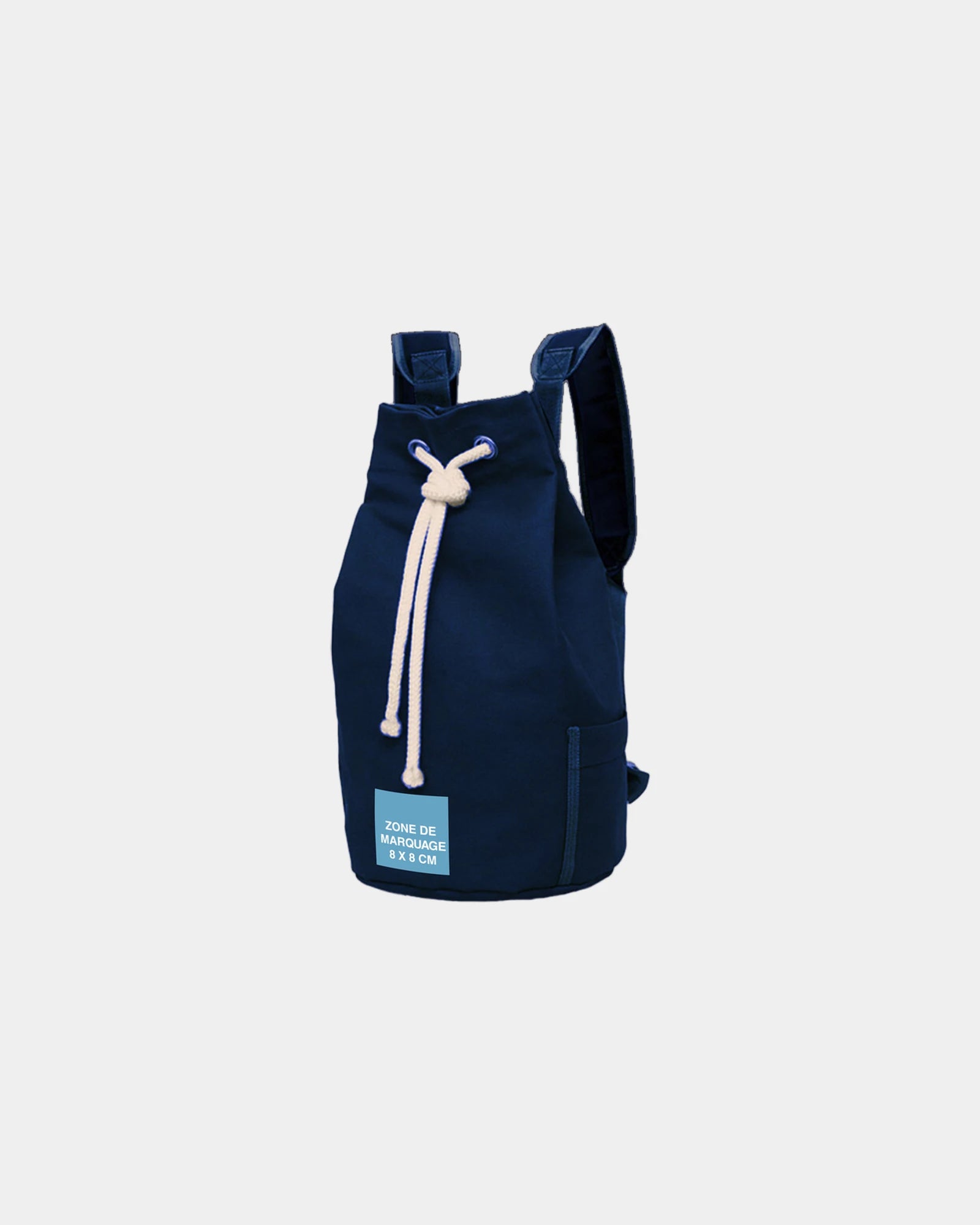
Pull the drawcord and the mouth gathers into a small puckered opening at the crown of the bag. That is the mechanism every other detail hangs off. There is no zip running a seam, no flap to lift, just a braided rope threaded through grommets that you cinch and knot in one motion. A sailor heaving kit onto a deck wanted speed and one fewer thing to fail, and the rope answers both.
The rope doubles as part of the carry. On many marine kit bags the same cord that closes the mouth runs down to form or anchor the shoulder sling, so closure and carry are one continuous loop. That keeps the silhouette clean and means there is no clip to snap under a wet, heavy load on the way back from a regatta or a pitch.
Grommet count and quality decide whether the closure lasts. Solid brass or stainless eyelets, spaced evenly round the mouth, spread the strain when the cord is hauled tight on a full bag. Pressed tin rings on a cheap bag tear out of the canvas within a season. On a club or crew order that gets cinched daily, brass grommets are worth confirming on the spec.
The drawcord, whipped ends and ditty-bag heritage of branded kit bags
The cord itself is part of the story. A triple-braided rope, often in natural hemp-look cotton or a dyed marine shade, whips and waxes at its ends so it never frays through the grommets. That whipped, knotted finish is a direct lift from a ship's ditty bag, the small drawstring pouch a sailor kept tools and twine in below deck.
The knot does the sizing on a rope-carry bag. A simple sliding hitch lets the same cord lengthen for an over-the-shoulder sling or shorten to a hand carry, so one bag adjusts to the wearer without buckles. A festival-goer slings it long across the body; a crew member shortens it for a quick grab off the deck.
That stripped-back, no-hardware build is why personalised sailor bags suit a heritage gift run. Personalised travel gifts sit naturally beside it in a sailing-club or tour welcome pack, where the rope-and-canvas look reads as considered rather than corporate across the whole set.
| Configuration | How it closes | How it carries | Suits |
|---|---|---|---|
| Rope-through-grommets | Cinch and sliding hitch | Same cord forms the sling | Heritage, lightest build |
| Drawcord plus webbing strap | Rope cinch at the mouth | Separate padded strap | Heavy daily crew use |
| Drawcord plus rope handle | Rope cinch at the mouth | Short rope grab loop | Quick deck or gym carry |
| Toggle drawcord | Spring toggle, no knot | Webbing sling | Festival, fast pack-down |
Heavyweight cotton-canvas and waxed bodies for personalised sailor bags
Why canvas weight sets the whole feel of personalised sailor bags
The body cloth is the first thing a recipient reads on a branded sailor duffle bag. A dense, heavyweight duck stands up on its own and signals a considered piece, where a thin sack reads as a giveaway from the first lift.
The cloth is the heritage. A true sailor bag is cut from heavyweight cotton canvas, often in the 340 to 410 gsm band. The dense duck weave stands up on its own when the bag is only part-filled. That weight is why a naval kit bag held its shape stacked in a locker, and why it reads as a considered object rather than a thin giveaway sack.
Waxed canvas is the upgrade that turns the bag coastal-ready. A paraffin-and-oil wax finish, often quoted around 10 to 18 ounces of cloth before waxing, makes the surface shower-resistant and lets it earn a patina with use. The trade-off is plain: wax stiffens the hand and the colour deepens unevenly over years, which crew buyers love and a gift recipient should be told to expect.
On personalised sailor bags, plain unwaxed canvas stays lighter and softer for a festival or gym carry, and it takes a printed mark more crisply than a waxed surface does. Choose waxed where the bag lives near salt water and weather; choose dry canvas where the look and the print matter more than the soaking. The base cloth you pick is named on each model's tech sheet.
| Cloth | Weight band | Water behaviour | Best for |
|---|---|---|---|
| Cotton canvas | 340-410 gsm | Absorbs, dries slow | Festival, gym, event kit bag |
| Waxed canvas | 10-18 oz pre-wax | Shower-resistant, patinas | Sailing club, coastal crew |
| Recycled sailcloth | Mill-dependent | Stiff, weatherproof | Heritage, sustainability-led order |
| Canvas-poly blend | Lighter hand | Coated option | High-volume budget run |
The tall side panel as the print area on custom sailor duffle bags
Placing a crest on the standing face of branded kit bags
The upright panel is where a marine kit bag earns its keep as a brand surface. A crest centred on that face reads down a pontoon, so the placement decision matters as much as the artwork itself.
Stand the cylinder up and the long side becomes a vertical billboard, frequently 35 to 45 centimetres tall and unbroken by a zip or pocket. A boat name, a crew number or a club crest prints down that standing face and reads from along a pontoon or across a festival field. A flat barrel holdall laid on its side cannot match that vertical reach.
The curve still matters, so artwork wants the front quarter of the cylinder where the cloth sits nearest to flat. A crest centred on that standing panel holds its lines; a wide logo wrapped toward the side seams bows on the curve. Supply the artwork and we lock it to the upright flat zone rather than stretching it round the tube.
The crown above the drawcord and the round base are secondary marking spots. A small monogram near the mouth catches the eye as the bag is shouldered, and a printed number on the base sorts identical crew bags stacked in a club store. Branded travel bags give a flatter zip panel where a wraparound logo behaves, so the two formats suit different artwork shapes.
Screen print, embroidery and the marine-navy look on personalised sailor bags
Heavyweight canvas was made for embroidery. A stitched crest or a yacht-club burgee sinks into the dense weave and stands proud without a stabiliser fight. That raised, tactile finish suits a heritage sailor bag far better than a flat transfer. Thread holds through salt, sun and repeated soakings where a printed film can lift at the edges.
Screen printing lays a bold block logo or a Breton-stripe motif across the standing panel for a high-volume crew or festival run. One or two solid colours on dry canvas cure hard and cost least per unit at scale. A waxed surface resists ink, so a printed mark on waxed cloth is best kept simple or moved to a sewn-on canvas patch.
The classic palette is the look people buy. Marine navy with a natural-canvas contrast, ecru with a navy drawcord, or a Breton blue-and-white stripe panel all read instantly as nautical. Custom duffle bags cover the modern coloured barrel holdall, where the personalised sailor bag holds the marine heritage corner of the range.
| Method | Sits best on | Colour range | Effect |
|---|---|---|---|
| Embroidery | Dry or waxed canvas | Thread-bound | Raised heritage crest |
| Screen print | Dry canvas, standing panel | 1-3 solid | Bold club or event logo |
| Woven or canvas patch | Any body, sewn on | Full | Sailcloth heritage badge |
| Vinyl number | Flat base or crown | Per colour | Crew and boat sorting |
The single shoulder strap and how branded kit bags carry
A personalised sailor bag carries on one shoulder, not two. A single broad strap, in webbing or in the same rope as the closure, runs from the crown to the base. The cylinder then rides upright against your back with the mouth at your shoulder. That one-strap carry is deliberate: it leaves a hand free for a rail, a gangway or a kit trolley.
Strap width and padding decide comfort once the bag is loaded. Bare rope or thin webbing bites under a full 40-litre kit, so a padded shoulder pad or a wide canvas strap is worth specifying on anything a crew hauls regularly. For a lighter festival or gym carry, a plain webbing sling is fine and keeps the bag true to its stripped-back form.
Anchoring is where load goes wrong. A strap stitched only to the side cloth peels away under a heaved kit bag. One that runs under the reinforced base, where the canvas is doubled, takes the weight into the strongest seam. On a crew run that gets slung daily, that base anchoring is the detail to check before you commit.
Capacity and the cylindrical load of personalised sailor bags
A personalised sailor bag is measured by its cylinder, roughly a height against a diameter, and it swallows soft, bulky kit beautifully. A 30-litre marine bag at about 50 by 30 centimetres takes a wetsuit, a towel, deck shoes and a change for a day on the water. Soft layers pack down the open mouth far better than anything rigid.
The top-load shape has one clear limit: there are no internal shelves, so a laptop, a framed award or anything that must lie flat travels poorly inside it. The bag is built for foul-weather gear, festival camping kit, gym layers and tour laundry, not for structured cargo. Knowing that keeps a crew or staff order specced for what the bag actually does.
Larger naval-pattern bags run 60 to 70 centimetres tall and tip into expedition territory. A 70-litre kit bag carries a full sailing wardrobe or a week of festival kit, and it collapses to a thin roll once emptied for compact storage. Match the height-by-diameter to the load, because a bag specced too small is the first thing a crew grumbles about.
| Size | Approx. capacity | Carries | Typical buyer |
|---|---|---|---|
| 45 x 25 cm | 20-25 L | Day kit, gym layers, towel | Gym, club day bag |
| 50 x 30 cm | 30 L | Wetsuit, deck shoes, change | Sailing club, coastal crew |
| 60 x 30 cm | 40-45 L | Weekend kit, festival camping | Crew tour, event giveaway |
| 70 x 35 cm | 60-70 L | Full wardrobe, expedition kit | Naval-pattern, heavy-duty order |
Reinforced base and seams that keep custom sailor duffle bags standing
Drop a loaded kit bag onto a wet jetty a hundred times and the base takes every landing. A reinforced round base, doubled canvas or a sewn-in leather disc, is what stops the bottom blowing out and lets the bag stand upright when filled. That standing posture is half the appeal, because a bag that flops on its side hides its printed panel.
Seam construction round the base and up the side carries the rest. Felled or double-stitched seams, rather than a single run, hold the cylinder together when the rope is cinched hard on a packed bag. A leather or webbing patch at the grommet line spreads the closure strain into a reinforced band instead of bare cloth.
These details are what separate a heritage kit bag from a costume version. A cheap sailor-look bag prints the part but tears at the base or pulls a grommet within a season. Custom drawstring bags take a different, lighter route for squad kit, while the sailor bag takes its toughness from doubled canvas and double-stitched seams.
Coastal crews, regattas and festival use for personalised sailor bags
A sailing club kits out its crew with 30-litre personalised sailor bags in waxed marine navy, the burgee embroidered on the standing panel and a number on the base for the boat. The same bag then walks off the water into the car park and the pub. It carries the club name well past the race weekend at no further outlay to the committee.
Festivals and outdoor events are where the look sells hardest. A cotton-canvas sailor bag screen-printed with a stripe and a logo reads as a styled merch piece rather than a freebie, and campers actually keep and re-pack it. A low minimum order lets a small festival or a coastal café brand a modest batch in one shade without a crew-sized commitment.
Corporate away-days near the coast lean on the same heritage cue. Personalised beach bags sit alongside the sailor bag for a seaside conference or a sailing-themed team day. The shared marine look ties a welcome set together without a word of explanation.
- Spec your sailor duffle bags by: height-by-diameter for the kit, not size labels
- waxed canvas near salt water, dry canvas for crisp print
- brass grommets on a daily-cinched mouth
- a padded or wide strap past 30 litres
- a doubled or leather-disc base so the bag stands
- embroidery on the canvas for a heritage crest
Gifting, crew sets and pairing branded kit bags
A sailor bag makes a strong standalone gift because the heritage form does the work without a gimmick. An ecru bag with a navy drawcord and a stitched name lands as a considered present for a sailing enthusiast, a retirement or a milestone birthday. A generic holdall simply would not.
For a crew or a staff coastal trip, one cloth and one shade across the whole batch lets personalised sailor bags read as a single outfit on the pontoon. Machine-stitched initials near the mouth give each member their own bag off a single artwork setup, so a club store stays sorted at a glance.
A boxed presentation lifts a single gift well past the bare bag. Corporate Gift Boxes let a sailor bag arrive as the centrepiece of a coastal welcome pack rather than passed across a desk unwrapped to a recruit or a club joiner.
Matching personalised sailor bags to the brief at a glance
Crews, festivals and gift buyers each pull the marine kit bag toward a different build. The grid below sets a common brief against the cloth, size and finish that tend to suit it, so a buyer can shortlist before opening a single product page.
| Brief | Cloth and size | Suggested finish |
|---|---|---|
| Sailing club crew | Waxed navy, 30 L | Embroidered burgee, base number |
| Festival merch | Dry canvas, 40 L | Screen-printed stripe and logo |
| Heritage gift | Ecru canvas, 25 L | Stitched name near the mouth |
| Naval-pattern kit | Recycled sailcloth, 60-70 L | Sewn-on canvas patch |
Read the grid as a starting point. A coastal café branding a small batch can share a model with a racing crew kitting twenty members. Only the cloth and the marking method change between the two orders.
Care, patina and re-waxing for custom sailor duffle bags
Heavyweight canvas wants a low-fuss routine, which is part of why it lasts. Brush off dried salt and mud, then spot-clean with cold water. Never machine-wash a waxed body, since heat and detergent strip the wax and lift the patina the owner has earned. A dry-canvas bag tolerates a cool hand-wash, but a stitched crest still prefers spot-cleaning.
Waxed bags re-wax rather than wear out. After a few coastal seasons the surface dulls and water stops beading, at which point a fresh bar of paraffin-and-oil wax rubbed in and warmed restores the shed. That refresh is the difference between a bag binned at three years and one handed down, and it is worth flagging to a gift recipient.
Tell crew the patina is the point, not a fault. Waxed canvas darkens unevenly at the creases and the strap, marking where the bag has been carried, and that lived-in look is exactly what coastal buyers pay for. A printed mark on dry canvas, by contrast, stays flat and bright and suits a brand that wants the logo crisp for years.
Order quantities, timing and sign-off for custom sailor duffle bags
Stock marine bags carry a low entry point, enough for a single crew or a small coastal café to brand a tidy batch. Expect a floor of roughly a couple of dozen pieces, set by model and chosen finish. A racing crew tends to order between twelve and thirty. Larger festival or multi-team runs reach into the hundreds, which trims the per-piece cost and unlocks waxed cloth and dyed-to-match cord.
Reckon on roughly twenty-one days from the moment you approve the proof. A flat screen print on dry canvas turns around soonest; stitched crests on heavy cloth, a sewn-on patch and per-piece monogramming each push the schedule out a little. A waxed batch or a bespoke-dyed rope takes the most time, because the cloth and cord are finished to your brief.
On sustainability we point you to the document, not a slogan. A body woven from recycled sailcloth or grown as organic cotton carries that status on its own tech pack. We forward that line's sheet for whichever base you are weighing up. Nothing is cut or stitched before you have signed off the digital proof and the crest position on the upright panel.

