

Corporate solar chargers
- Price, low to high
- Price, high to low














Treat your clients and employees!

FAQ - Custom solar chargers
Trusted by 1,000+ companies
What the panel wattage on branded solar chargers actually collects
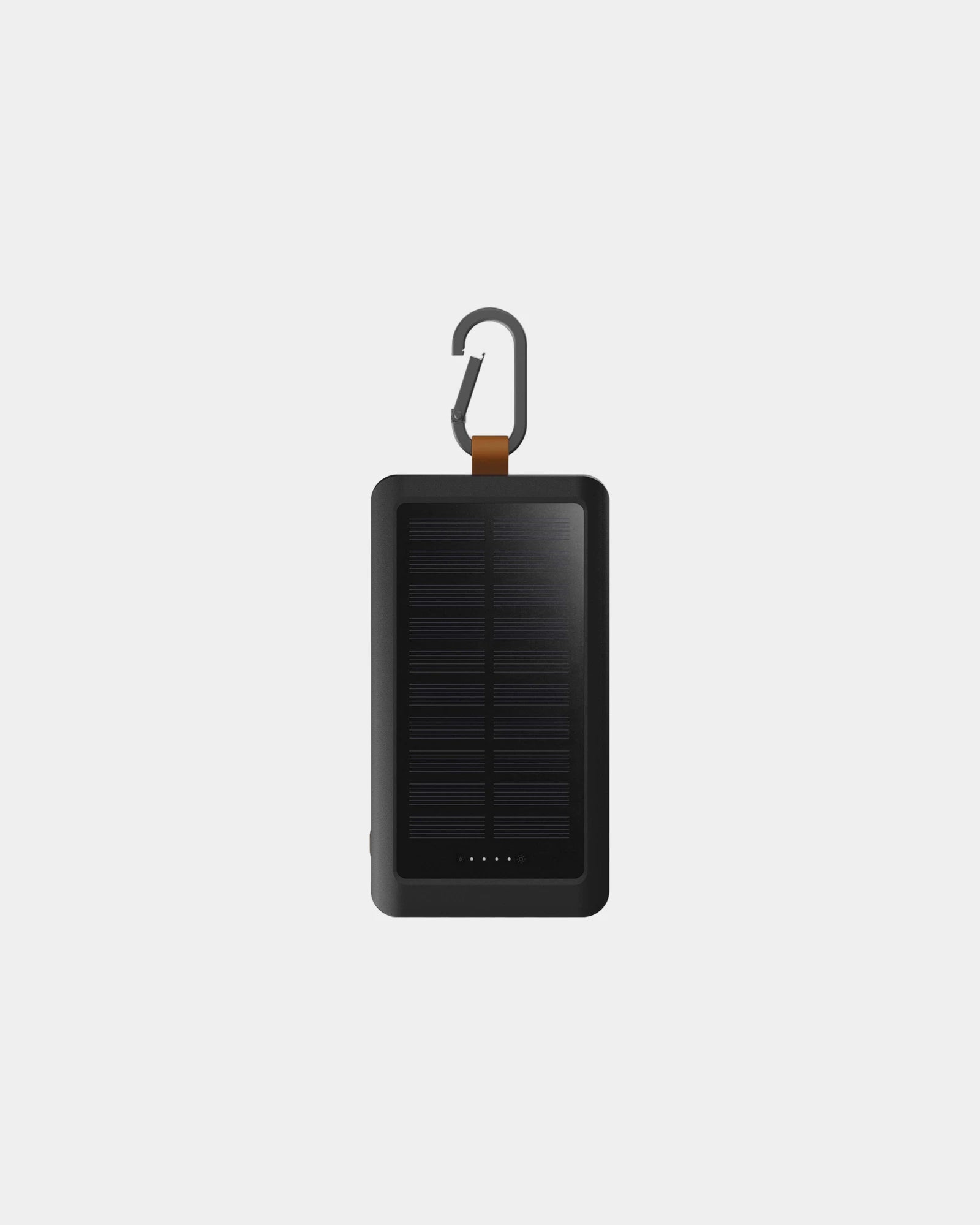
The number printed beside the panel is its peak output in watts, measured under bright laboratory sun. It is the spec that separates a token panel from a working one. A pocket solar power bank carries a single small cell rated around 1W to 2W, enough for a slow trickle but not a primary charge. A dedicated folding charger spreads several panels to reach 10W, 21W or 28W, model-dependent.
Panel area drives that figure more than anything else, because a photovoltaic cell collects light across its whole face. A credit-card-sized panel on a slim power bank simply cannot gather what an unfolded A4-spread of cells does, whatever the marketing suggests. So judge a branded solar charger by the panel size first and the printed wattage second.
Cell chemistry behind branded solar chargers
Cell chemistry then refines it. Monocrystalline cells convert sunlight more efficiently than polycrystalline and read as a darker, more uniform black, which is why they dominate the better outdoor units. An ETFE or laminated coating over the cells lets more light through and shrugs off the odd scratch in a rucksack.
For audiences who only need a daylight backup, a compact solar power bank pairs well with everyday Branded power banks across a single tech line.
| Panel rating (approx.) | Format | Realistic role |
|---|---|---|
| 1W to 2W | Single cell on a pocket bank | Daylight trickle, backup only |
| 5W to 7W | Compact folding panel | Slow phone top-up in good sun |
| 10W to 14W | Two-fold to three-fold panel | Steady single-device charge |
| 21W to 28W | Four-fold to five-fold array | Faster charge or two devices |
How long a sunny day takes to refill promotional solar chargers
A festival crew leaving a power bank on a tent in the morning wants to know what it holds by dusk. The answer turns on the sun, not on us. Charge speed depends on the daylight a panel receives. So any timing below is the device's own rated behaviour in clear conditions, never a guarantee we attach to a campaign.
Run the rough arithmetic. A 10W panel in strong, direct, midday sun collects roughly 10 watt-hours an hour at best. A 10,000mAh lithium cell stores near 37 watt-hours, so a full solar refill from flat needs the better part of a clear day. A cloudy one stretches that well beyond a single day.
The variables are real and worth telling recipients plainly. Thin cloud, low winter sun, a panel laid flat instead of angled at the sun, or a phone drawing power while it charges all slow the fill. A panel propped to face the sun directly gathers far more than one lying on a bag.
That is why a branded solar charger is a top-up, not a primary source. Charge the cell by USB from the mains when you can, and let the panel extend the run between sockets. Framed that way, the panel is a genuine asset on an outdoor stand rather than an overclaim a buyer regrets.
Getting the most from personalised solar power banks in the field
Two recipients with the same solar charger can harvest very different amounts, and the gap comes down to how they use the panel. The single biggest factor is angle. A panel propped to face the sun square-on collects far more than the same panel lying flat on a rucksack lid. Flat, it catches the light at a glancing angle for most of the day.
Why shade hits personalised solar power banks so hard
Shade is the next variable, and partial shade hurts more than buyers expect. A shadow falling across even one corner of a multi-cell panel can drop its whole output sharply, because the shaded cells choke the current the lit cells try to push. Brief recipients to keep the full panel clear of branches, straps and tent fabric.
Heat and time of day shift the figure too. A panel runs most efficiently in cool, bright conditions, and very hot cells lose a little output, so a breezy clear morning often beats a sweltering midday haze. Mid-morning to mid-afternoon is the productive window, with the fill tailing off as the sun drops.
None of this needs a manual, just a line on the gift or the insert. A recipient who angles the panel at the sun and keeps it unshaded gets a usable charge where a flat, shaded panel barely registers. That is worth saying plainly to anyone relying on the unit.
| Condition | Effect on collection | Practical tip |
|---|---|---|
| Panel angled at sun | Best output | Prop or clip facing the sun |
| Panel flat on a bag | Reduced output | Re-angle when stationary |
| Partial shade on cells | Sharp drop | Keep the whole panel clear |
| Thin cloud / haze | Moderate drop | Expect a slower fill |
| Low winter sun | Low output | Treat as backup, charge by USB |
Folding multi-panel branded solar chargers for off-grid charging
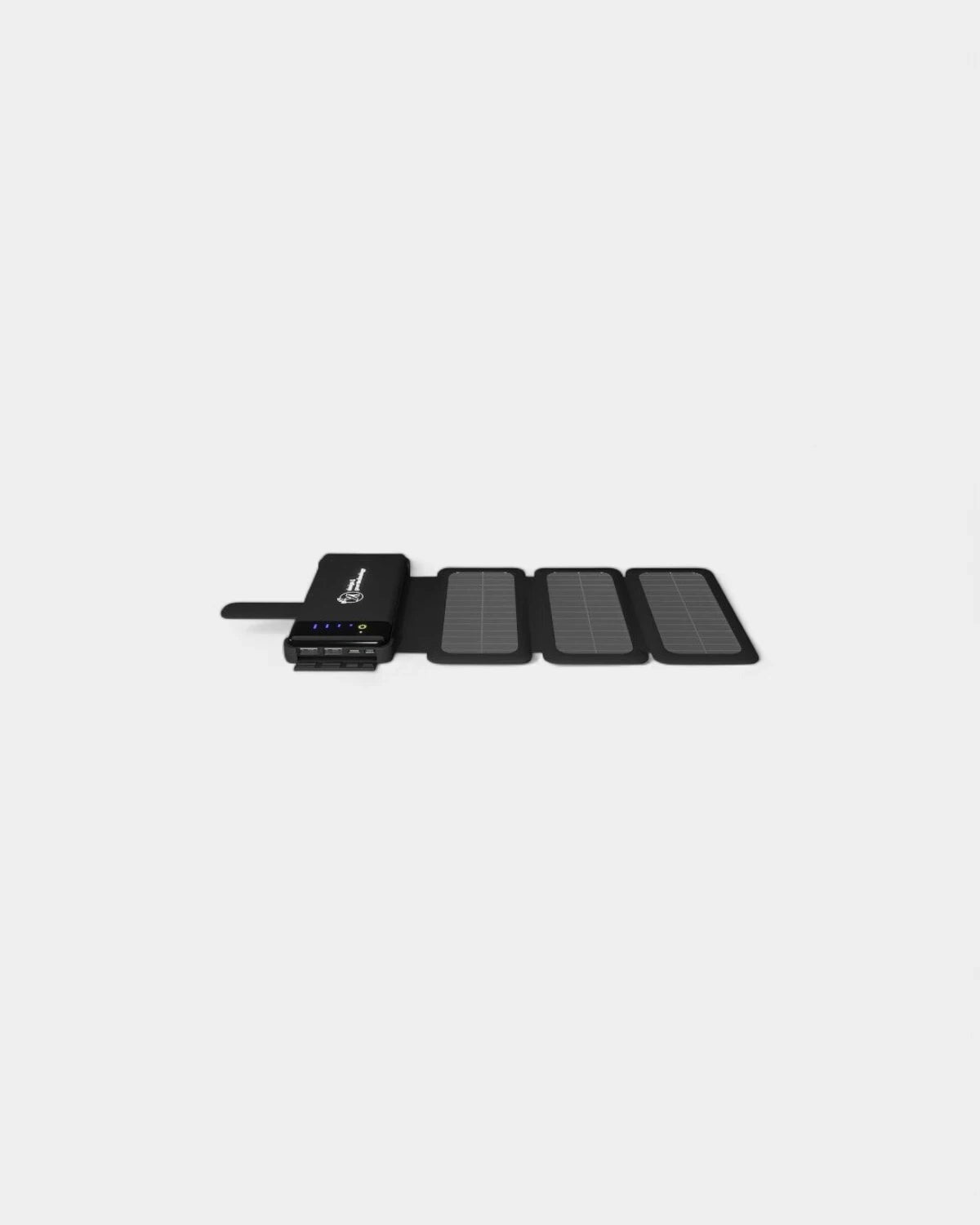
The fold-out format is what earns branded solar chargers their outdoor reputation. Two, three, four or five panels are stitched into a fabric wallet that opens like a map, then folds to roughly tablet size for a pack. Unfolded, the combined panel area collects far more light than any single cell, which is what lifts a unit from trickle to a usable field charge.
These chargers split into two kinds, and the difference matters to your brief. One folds out a panel array with a USB port and no internal battery, so it charges a separate power bank or a phone directly while the sun is up. The other builds a battery into the wallet, storing the day's solar harvest for an evening phone charge after dark.
Eyelets and a couple of carabiners are the small touches that make the format work. The recipient clips the open wallet to a rucksack, a tent guy-line or a stand frame, angling it at the sun while they walk or work. A kickstand on the larger arrays props the panels at the right pitch on the ground.
For an expedition or field giveaway, a folding solar charger sits naturally beside other carry kit such as Personalised travel gifts in a complete outdoor pack.
Rugged build and IP rating on promotional solar chargers
Outdoor kit lives a harder life than a desk gadget, so the build of a branded solar charger decides whether it survives a season or dies in a downpour. The headline spec is the IP rating, a two-digit code where the first digit covers dust and the second covers water. An IP65 unit resists dust ingress and low-pressure water jets; an IP67 unit tolerates brief immersion.
Read that rating against the use. A festival or worksite power bank wants at least splash and dust resistance, because mud, spray and grit are the daily reality. A unit rated only for indoor use will not last a wet weekend, so confirm the IP figure on the model's own data sheet before you commit the order.
Housing and sealing on promotional solar chargers
The housing does the rest of the work. A rubberised or shock-absorbing edge cushions a drop onto rock. A sealed port flap keeps water out of the USB sockets, and a toughened panel face resists the scuffs a rucksack inflicts. These are the details that separate a charger built for a trail from one dressed up to look like it.
A built-in LED torch and an SOS flash mode are common extras on rugged bodies. They turn the gift into emergency kit a recipient keeps in a glovebox or a go-bag. We can send a free sample so a buyer can judge the build in the hand before ordering a run.
| Spec | What it means | Best fit |
|---|---|---|
| IP54 | Splash and dust resistant | Festivals, day hikes |
| IP65 | Dust-tight, water-jet resistant | Worksites, expeditions |
| IP67 | Survives brief immersion | Watersports, wet climates |
| Rubberised housing | Cushions drops and knocks | Rough outdoor handling |
| LED torch / SOS | Light and emergency flash | Go-bags, glove compartments |
USB outputs and what promotional solar chargers drive in the field
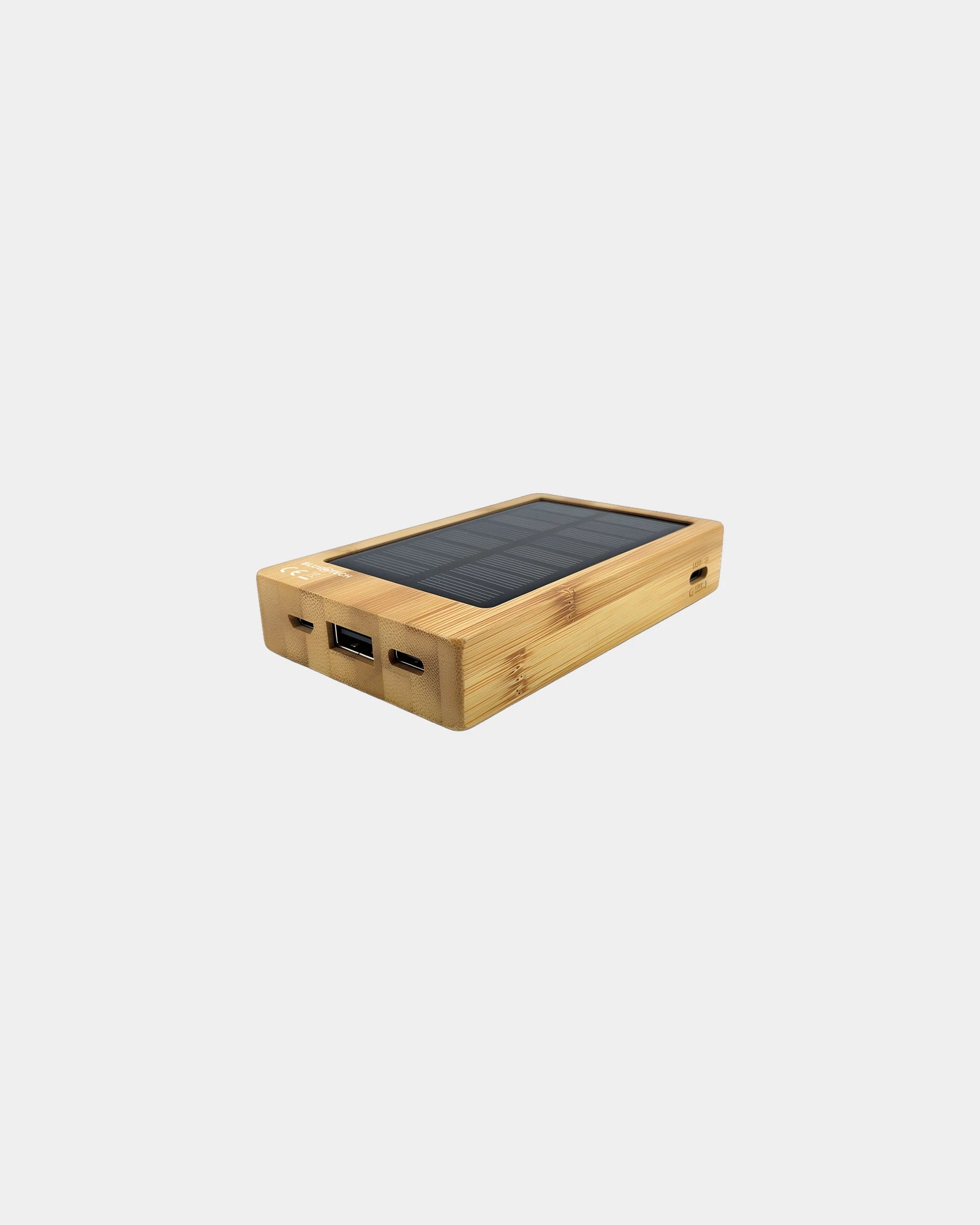
The output ports decide what a branded solar charger can actually run once the cell holds charge, and a field recipient cares about this more than the panel spec. A single USB-A port covers a phone. A second port, often USB-C, lets a phone and a head-torch or a handheld radio charge together, with the available power shared between them.
USB-C output is the spec to confirm for a modern audience, since most current phones and many cameras now charge over it and refill faster than from older USB-A. A unit that only carries USB-A still works through an adapter, but it dates the gift for recipients carrying newer kit.
The cell paired with the panel sets how much that output delivers before the sun has to top it up again. The same usable-charge maths applies as on any battery once you set the panel aside and look at the cell alone. A higher-capacity cell simply gives more field runtime per solar day.
Match the output to the field job. Branded solar chargers with two ports suit a team sharing one charger between a phone and a GPS unit. A single-port slim bank suits a solo handout where light weight beats the second socket.
Branded solar chargers as a sustainability and eco-incentive gift
A renewables firm running a stand at a green-energy expo is the buyer for whom branded solar chargers do double duty. It charges a phone and states the company's position without a word. The panel is a visible, on-message prop in a way a plain battery never is, which is why these suit eco-incentive schemes, B Corp campaigns and environmental days.
Keep the green claim accurate and the gift stays credible. The solar panel reduces grid draw for the charges it does cover, and that is a fair, modest point to make. We avoid blanket eco-labels on the charger itself. The recycled content of any rPET fabric wallet or recycled-plastic body is set per model and printed on that unit's spec sheet.
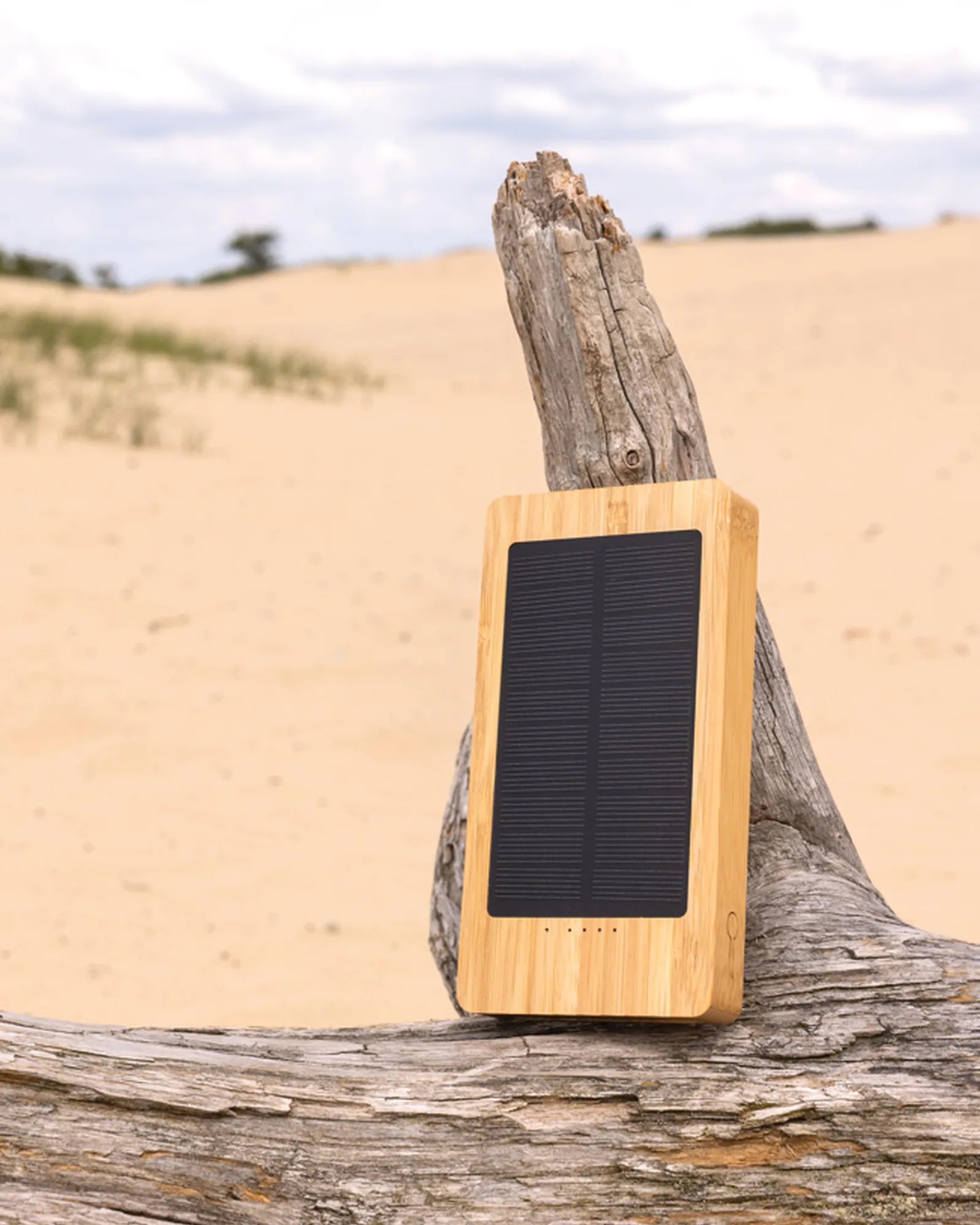
Bamboo-faced and recycled-plastic bodies extend the sustainability story to the casing, engraving cleanly for an understated, natural finish. A fabric folding wallet woven from recycled PET carries the message across the largest surface on the whole unit.
For a coordinated low-impact tech handout, the solar charger pairs with other on-brand Custom tech gadgets chosen for the same audience.
Marking and finishing on personalised solar power banks
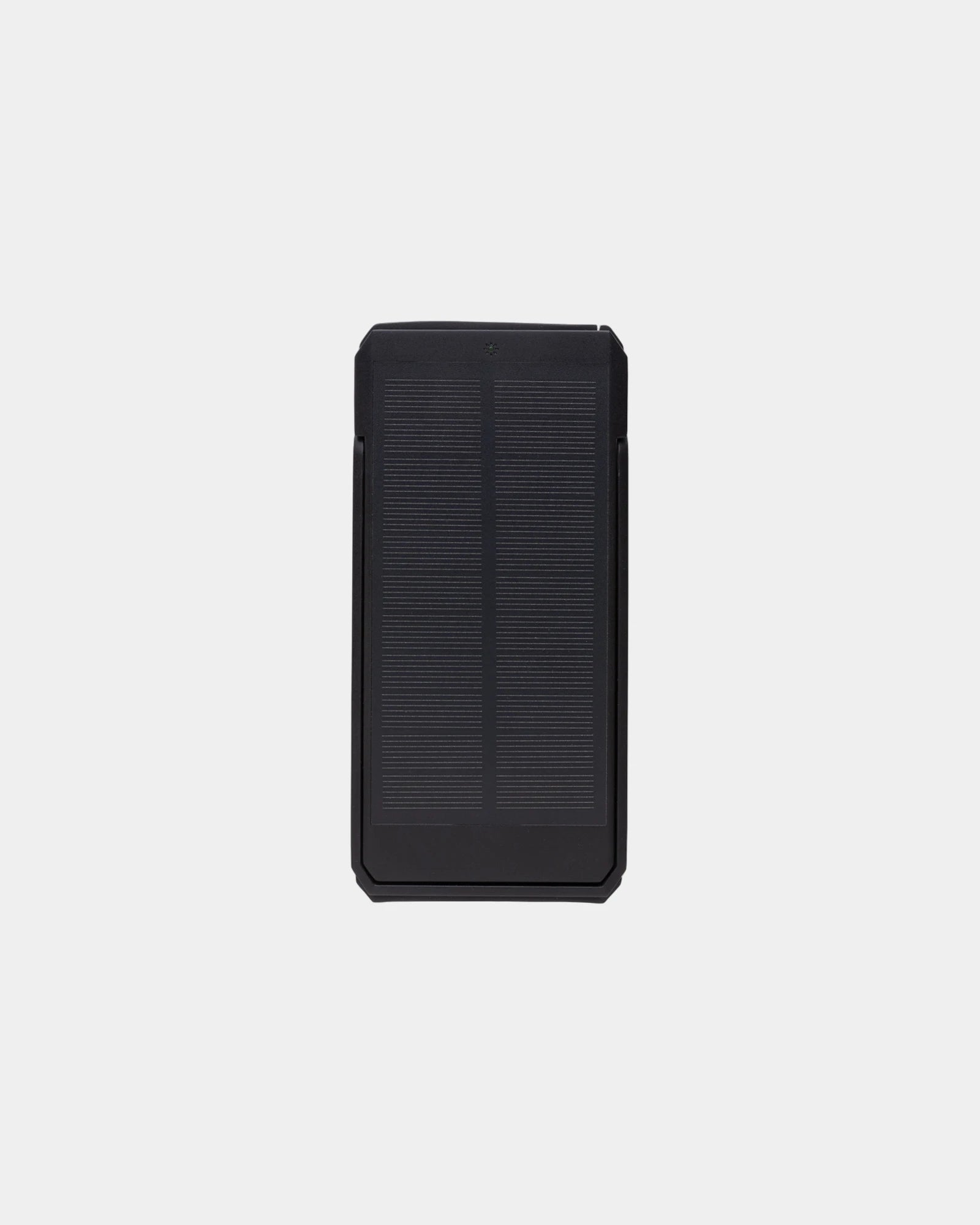
Personalised solar power banks brand differently from a flat pad, because the panel claims the prime surface. The print has to work around it. On a single-cell pocket bank, the logo sits on the casing beside or below the panel, so a compact, bold mark reads better than a fine lock-up.
On a folding charger, the fabric wallet is the branding canvas and a generous one. A woven label, a heat transfer or a printed panel on the closed wallet carries a full logo and a strapline, visible whenever the unit is clipped to a pack. The closed face is the surface a buyer should design for first.
Method follows the body the panel sits in. UV digital print lays full colour on a plastic casing. Pad print handles one or two solid colours on a curved edge. Laser engraving cuts a permanent mark into a metal or bamboo body that never rubs off.
Clean vector artwork and named brand colours make any method reproduce well across a run. We return artwork approval within 24 hours, so a buyer signs off the placement around the panel before production begins. For comparable charging-kit finishing, see Custom chargers.
| Method | Surface | Effect |
|---|---|---|
| UV digital print | Plastic casing | Full colour, fine detail |
| Pad print | Curved casing edge | One to two solid colours |
| Laser engraving | Metal, bamboo body | Permanent, no colour |
| Woven label | Folding fabric wallet | Textile-quality finish |
| Heat transfer | Fabric wallet panel | Large full-colour mark |
Festival and outdoor-event promotional solar chargers
Festival sites rarely offer fixed power, which is exactly the gap a branded solar charger fills for crew handouts and sustainability-village stock. Staff working a field can clip the panel to a gazebo and top up radios and phones through the day. The logo sits in the sun where every passer-by sees it.
The outdoor setting is the whole pitch here. A charger that survives mud, spray and a dropped tent peg reads as genuine festival kit, not a freebie that fails by Saturday lunchtime. Pair the unit's IP rating to the likely weather and the gift keeps working when a flimsier handout would have quit.
Event organisers and outdoor brands favour the format because it photographs well in use, on a tent, on a backpack, in the sun. That extends the campaign across social posts beyond the weekend itself. The panel makes the product its own advertisement in a way a pocket battery cannot.
A solar charger slots neatly into a festival or outdoor welcome pack, and a matching Corporate Gift Boxes presentation lifts a crew handout into a considered gift.
Expedition, field-team and emergency branded solar chargers
Multi-day deployments far from any socket are where higher-wattage folding branded solar chargers stop being a talking point and become essential kit. On a remote survey or a long expedition, the panel keeps a phone, a satellite messenger and a GPS alive across days without mains power.
For field teams the spec priorities flip. Panel wattage and a stored-energy battery matter more than the print, because a charger that cannot keep pace with the daily draw is a liability in the field. A 21W or 28W fold-out array with a built-in cell gives the headroom a multi-day deployment needs.
Emergency and resilience buyers think the same way. A rugged solar charger with a torch and an SOS flash belongs in a go-bag, a glovebox or a disaster-response kit. It keeps charging when the grid is down, and that dependability is why a recipient holds onto the unit for years.
These field-grade units suit utilities, surveyors, mountain crews and aid organisations, and the right output cabling matters as much as the panel. A solar charger ships well alongside matching Branded charging cables so a team carries the right tips from day one.
Who orders branded solar chargers, and how the spec shifts by sector
Few tech gifts read their buyer's intent as plainly as a solar charger, so the order changes shape by sector. Renewables, sustainability consultancies and green-energy firms order them as on-message handouts, where the panel says more about the brand than the logo does.
Outdoor and adventure brands, festival operators and travel companies favour rugged folding units that survive real field use, prioritising IP rating and panel area over a large print surface. Universities and events teams lean on compact solar power banks for delegate bags, where light weight and a clear eco story carry the gift.
Utilities, emergency services and aid organisations specify higher-wattage field units with stored energy and a torch, treating the charger as working equipment rather than a giveaway. Professional services choose a restrained engraved body where a discreet mark suits a formal recipient who still wants the green signal.
Matching the panel and the build to the audience matters as much as the logo. The gap between a 2W pocket bank and a 28W folding array is the gap between a gesture and genuine off-grid kit.
Conference and delegate-bag personalised solar power banks
Not every solar charger order heads outdoors, and the conference circuit is a steady home for the slim pocket format. A compact solar power bank drops into a delegate bag, weighs almost nothing and reads as a considered, on-message handout. The daylight panel signals an organiser thinking about sustainability, even where most charging still happens at a socket.
The brief here flips the field priorities. Weight, slimness and a clean print surface matter more than panel wattage, because a delegate tops up indoors and treats the panel as a backup. A 5W to 10W pocket unit with a bright UV-printed logo suits a summit, an awards night or a university open day better than a rugged folding array.
| Event | Format | Lead spec |
|---|---|---|
| Corporate summit | Slim pocket bank | Light weight, UV print |
| University open day | Compact 5W panel | Low cost, bright logo |
| Sustainability expo | Bamboo-faced bank | Engraved eco finish |
| Awards evening | Premium engraved bank | Discreet, considered mark |
Matching the build to a seated audience keeps the cost sensible across a large headcount. A delegate rarely needs off-grid wattage, so the spend goes into finish and presentation rather than panel area, and the gift still photographs well on a conference table.
Briefing your promotional solar chargers order well
A clean brief settles the panel before the finish. State where the charger will be used first, a delegate bag, a festival field or a remote deployment. Then size the panel wattage, the battery and the IP rating to that setting before you think about the print. Minimum orders typically start from approximately 25 units, which keeps a pilot run or a VIP batch accessible.
Larger volumes unlock keener per-piece pricing and a wider choice of panel size and body, so balance your spec, quantity and deadline together rather than fixing one alone. A 28W folding field unit and a slim pocket bank sit at very different price points for the same count.
Lead time runs around three weeks after artwork approval, with slim pocket banks usually turning faster than a moulded multi-panel folding charger. Work through the list below to lock the panel, the build and the finish before you brief us, and get anything model-dependent put in writing.
- Size the panel by use: 1W to 2W backs up, 21W to 28W charges off-grid
- Treat the panel as a top-up
- charge the cell by USB when a socket is near
- Confirm the IP rating against the weather the unit will meet
- Choose a folding array for field charging, a pocket bank for delegate bags
- Specify USB-C output for modern phones and cameras
- Add a torch or SOS mode for emergency and go-bag recipients
- Minimum orders start near 25 units
- lead time around three weeks

