Branded conference folders
- Eco-friendly
- Made in Europe
- Price, low to high
- Price, high to low
Treat your clients and employees!
FAQ - Promotional conference folders
Trusted by 1,000+ companies
What a zip-around organiser changes about branded conference folders
The zip-around closure runs the fastener on three edges, so the whole organiser shuts into a sealed slab. Loose handouts, a calculator and a phone stay put when a manager slings it into a bag between two buildings on the same site.
That sealed shell is the difference between a portfolio and a plain document wallet. A wallet protects paper. These branded conference folders hold a working desk inside, with a writing pad, a pen and a device pocket all closed behind one zip. The recipient carries a whole workstation in one hand rather than a sheaf of paper that needs a bag around it to stay together.
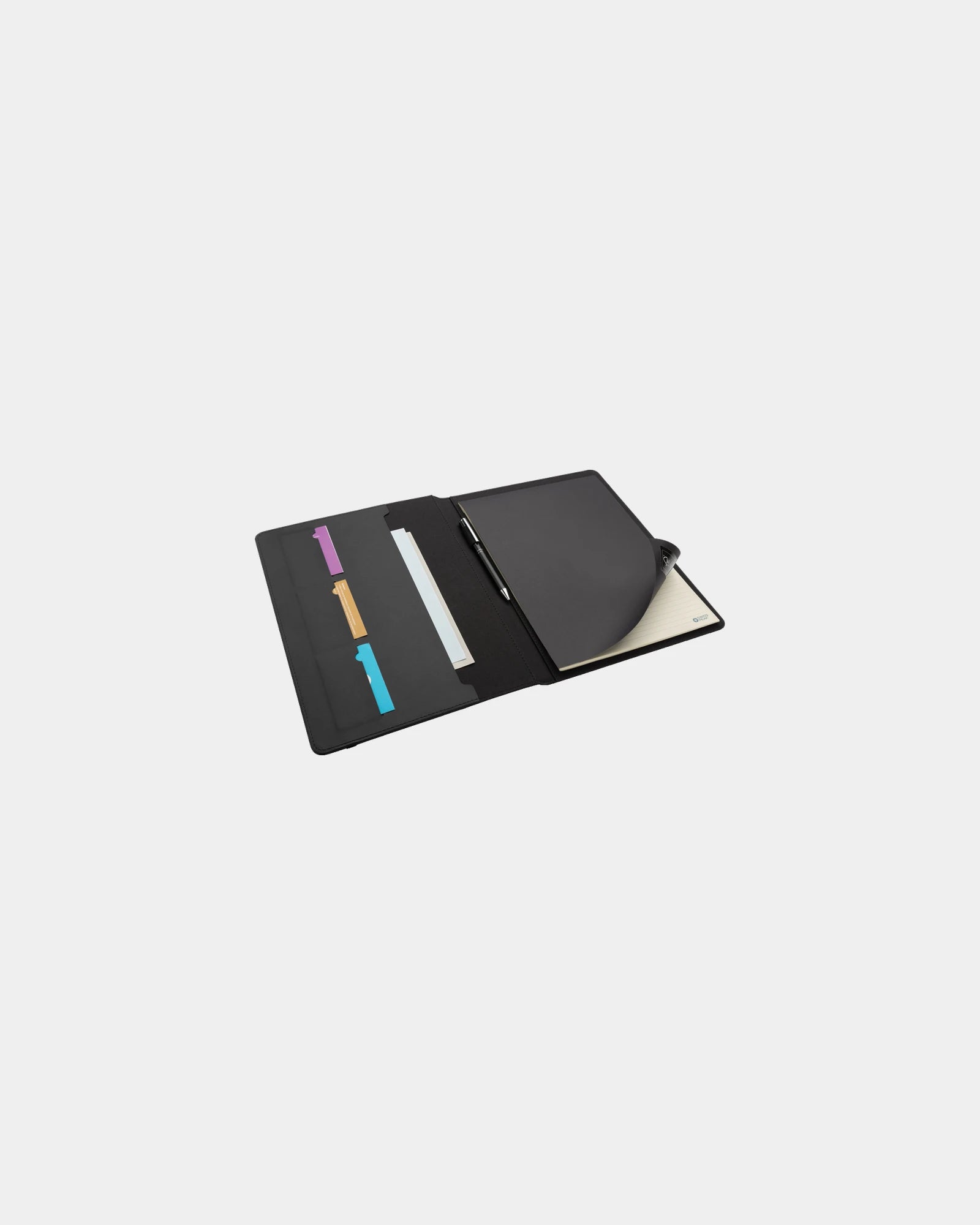
Open it flat on a table and the two inner faces become a left-hand and right-hand workspace. The notepad and ring mechanism sit on one side. The slots, the tablet sleeve and the calculator sit on the other. Everything a meeting needs faces up at once, so the user works from one open surface rather than reaching into a bag.
That layout is what separates a portfolio from a stack of loose tools. A delegate who opens the cover finds the pen already in its loop, the cards already in their slots and the pad already squared to the rings. Nothing has to be assembled at the table. That is the quiet reason a sealed organiser reads as a more considered kit than a branded conference folder and a pad handed over separately.
The ring mechanism that defines custom conference portfolios
Sizing the ring on promotional conference folders
Drop a two-ring or four-ring mechanism inside the cover and the branded conference folder stops being a wallet and becomes a binder you refill. A finance team punches its rate cards once and reorders nothing for a year, replacing only the sheets that change.
A 20mm ring takes roughly 120 sheets of 80gsm stock, a 25mm ring near 180, model-dependent, so the diameter is matched to the bundle you genuinely carry. Loaded to its rated ceiling a ring makes the tabs bind, so we specify one diameter above the live page count.
A four-ring layout holds an A4 sheet at four separate punches, so pages lie flatter and tear less than a two-ring spine under daily use. The lighter two-ring suits a thinner reference set carried between calls rather than worked all day. Personalised notebooks sharing that hole pitch clip straight in alongside the punched handouts, so the writing journal lives on the rings rather than loose.
Closure hardware and spine on promotional conference folders
The zip itself is a spec worth naming, not an afterthought. A chunky metal or moulded coil zip survives years of daily opening, while a fine nylon zip on a giveaway folder is built for lighter use. We match the gauge to how hard the organiser will be worked.
A press-stud or elasticated strap is the lighter alternative where a full zip is overkill. The strap opens in one pull at a desk, though it gives up the sealed-on-three-sides security a rep wants in a car boot. The two answer different briefs rather than one beating the other, so the closure follows the carry rather than a house preference.
The spine flexes as the ring pack and the paperwork thicken, so a gusseted spine lets the cover grow without straining the zip teeth. A flat-spine folder stays trim for a thin reference set, while a 30mm gusset takes a fuller bundle and still zips shut clean. Specifying the gusset against the fullest the branded conference folder will ever get, not its empty state, is what stops a zip straining once a course pack is loaded.
Fitting a tablet and a calculator inside branded conference folders
The interior is where branded conference folders earn the desk comparison. An elasticated sleeve stands a 10-inch tablet upright next to the paperwork. A rep then reaches a pitch with one closed item in hand, not a device in one grip and a branded conference folder in the other.
A solar or battery calculator seats in a cut-out on the inner face, kept where the numbers get worked rather than fished from a pocket. Sales and finance briefs lean on this, since a quote gets totalled on the spot without a phone coming out. Reaching for a handset to add up a figure can read as distracted in front of a client. The seated calculator keeps the moment professional, and the working visible on the desk.
Cable and card management runs alongside. A row of business-card slots, a clear ID window and a USB or pen-drive loop turn the inner face into a tidy control panel. Branded power banks slot into the device pocket so a tablet stays charged through a full day of back-to-back sessions.
| Fitting | What it holds | Typical brief |
|---|---|---|
| Ring mechanism | 120 to 180 punched sheets | Finance, training packs |
| Tablet sleeve | 10-inch device, elasticated | Field sales pitches |
| Calculator cut-out | Solar or button-cell unit | Quoting on site |
| Card and ID slots | 4 to 6 cards, name badge | Client meetings |
| USB and pen loop | Drive, branded pen | Issued staff kits |
Choosing the cover material for promotional conference folders
PU and bonded leather carry most corporate runs of branded conference folders, since both hold a clean deboss and stay soft to the touch after months of opening and zipping. A bonded-leather organiser reads as the considered choice for a director-level kit.
PVC and 600D polyester make a wipe-clean, knock-tolerant shell for staff working a factory floor or a trade stand. A coffee ring that would stain a leather-look cover lifts straight off these. We brief you on which material suits the carry before a quote goes out. The choice tends to follow the environment more than the budget, since a cover that scuffs on day one undercuts the issued-kit look a buyer paid for.
Heft signals the tier before a logo registers. A padded bonded-leather A4 cover sits heavy and reassuring in a client's hand; a slim PVC organiser reads as a practical issued tool. Personalised Pencil Cases in a matched colour extend a field kit, since they take the same knocks as the cover without scuffing.
Decorating the cover of custom conference portfolios
Picking a logo finish for custom conference portfolios
How the logo lands depends on the shell. A deboss sinks an ink-free mark below the surface of a PU or leather-look cover, a finish that never rubs away inside a bag. Foil blocking lays a metallic shine over that deboss for a boardroom-grade portfolio.
Screen and pad print lay durable spot colour onto PVC and polyester, where a press die cannot bite into the surface. A blind deboss inside the flap and a foiled front mark each carry a separate minimum, so the technique is matched to the panel and material before quoting.
A pen sits at the centre of the kit, so the barrel finish wants to read against the cover. Personalised pens seated in the loop with a matched deboss make the folder and pen look like one designed piece rather than two items dropped in a bag.
Every method here changes only the top skin of the cover, so the working build underneath stays intact. The ring mechanism still turns, the zip still seals on three sides, and the tablet sleeve still grips. We strike the die on the outer panel away from the spine flex, so the mark sits flat and the cover still closes square over a full bundle.
On a PVC or polyester organiser a screen print sits on the surface without piercing the wipe-clean face, so a coffee ring still lifts off after branding. We keep the print clear of the zip seam and the gusset fold. A thick ink lay there would crack as the spine expands. The result is a folder that reads as branded kit but works exactly as the unmarked base does.
| Method | Best cover | Colour | Min qty approx. |
|---|---|---|---|
| Deboss | PU, bonded leather | Tonal, no ink | 25 to 50 |
| Foil block | PU, leather | Single metallic | 25 to 100 |
| Screen print | PVC, polyester | 1 to 4 spot | 50 to 100 |
| Laser engrave | Selected PU | Tonal etch | 25 to 50 |
Sizing promotional conference folders to the documents and device
A4 is the working default, since a contract, a proposal and a punched handout all drop in flat with no fold. The ring mechanism and the tablet sleeve both demand that footprint, so most organiser briefs settle here rather than at a pocket size.
A5 suits a slimmer carry, the format for someone moving little more than a handset, a business card and brief notes. The trade-off is real. A4 paperwork folds to fit, and a full-size tablet will not seat in an A5 sleeve. Name the bulkiest item the cover must carry and the right size usually decides itself. That is why we ask what goes inside before recommending a footprint, rather than defaulting to the larger cover.
The brandable area grows with the cover. An A4 front offers a wide panel for a foiled mark or a debossed crest. An A5 holds a neater emblem that still reads at arm's length across a meeting table. A buyer choosing between the two is really choosing how much presence the logo carries. The larger panel lets a crest sit bolder, while the smaller one keeps the mark discreet on a pocket organiser.
| Format | Fits | Best for |
|---|---|---|
| A5 zip portfolio | Notepad, phone, a few cards | Compact meetings and sales visits |
| A4 ring binder | Full A4 documents, tablet, calculator | Conferences and training packs |
| A4 zip-around | A4 pad, tablet, cables, pen | Executive organiser and field sales |
| Expanding file | Thick handouts and dividers | Multi-day events and course kits |
Specifying branded conference folders for issued sales and training kits
Forty field reps each want one sealed organiser holding the tablet sleeve, the calculator and the card slots, so nobody arrives at a pitch juggling two items. Each cover can carry a rep name or a region marked on the run, which makes an issued tool a personal one the rep holds onto.
A training team running a course over several days reaches for the ring mechanism instead, slotting punched modules in sequence and replacing a single sheet when content shifts. One cover then serves intake after intake with no reprint of the full pack. We return a digital proof within 24 hours of your artwork, and can run a single sample folder for sign-off before a large issued order is committed.
A kit hangs together from the spec rather than the packaging. A locked Pantone colour and one shared deboss die run across the cover, the pen and the slot-in pad. That held spec lets a later top-up batch line up with the first. The approved file stays on record so the second intake matches the original run.
- Inner fittings worth naming on the brief:
- Elasticated 10-inch tablet sleeve
- Solar or button-cell calculator cut-out
- 2-ring or 4-ring punched mechanism
- Four to six business-card slots
- USB or pen-drive retention loop
- Gusseted pocket for a thick bundle
Eco choices across custom conference portfolios
A bonded-leather or PU organiser is the long-life route, kept and reused across years of meetings rather than binned after one event. That suits a buyer weighing durability against recycled content. The ring mechanism extends the life further, since refilling sheets replaces buying a fresh folder.
Where a lighter handout is the brief, the slot-in pad can be specified on recycled-content stock and a blind deboss puts no ink on the cover at all. The recycled share varies cover by cover, so the figure for the model you choose appears on that line's data sheet rather than as one blanket number.
Branded conference folders inside a wider welcome kit
A welcome kit reads as one issued set when the branded conference folders carry the same colour and logo placement as the pieces beside it. Corporate Gift Boxes present the portfolio, a pen and a power bank as one opening. The folder then lands as a deliberate gift, not loose stock dropped in a bag.
Not every brief needs the sealed organiser, though. A buyer handing out a few hundred lightweight delegate folders wants the open-flap carry. There a handout slides in and out with no zip or ring mechanism in the way.
That lighter, document-wallet end of the range sits on its own page. Printed conference folders cover the flap and slim-wallet brief, so a buyer who wants the unzipped handout rather than this workstation portfolio starts there instead. Matching the cover colour and logo position across the two pages keeps a mixed order looking deliberate. The executive portfolios and the bulk delegate wallets then read as one set, even when they ship as separate specs.
Use cases for promotional conference folders by sector
Each sector builds the organiser around a different inner fitting and a different audience. A field sales force wants a zip-around with a tablet sleeve and a calculator. A finance team wants a ring binder for punched rate cards. An executive onboarding kit wants a bonded-leather cover that opens as a welcome. The sector sets the build before the colour.
Promotional conference folders work hardest when the fittings match the work the recipient does daily. The table below maps the common sectors to the organiser they tend to order and the reason it fits.
| Sector | Typical organiser | Why it fits |
|---|---|---|
| Field sales | Zip-around with tablet sleeve | One sealed item carried into a pitch |
| Finance and insurance | Ring-binder portfolio | Holds punched rate cards, refilled yearly |
| Training providers | Four-ring A4 binder | Swaps modules without a full reprint |
| Executive onboarding | Bonded-leather zip cover | Reads as a considered welcome gift |
| Trade-stand teams | PVC or polyester organiser | Wipes clean after rough stand use |